By Joan Nwagwu
The Nigeria Social Insurance Trust Fund (NSITF) and South Africa’s Rand Mutual Assurance (RMA) have commenced a strategic partnership aimed at strengthening social protection systems across Africa.
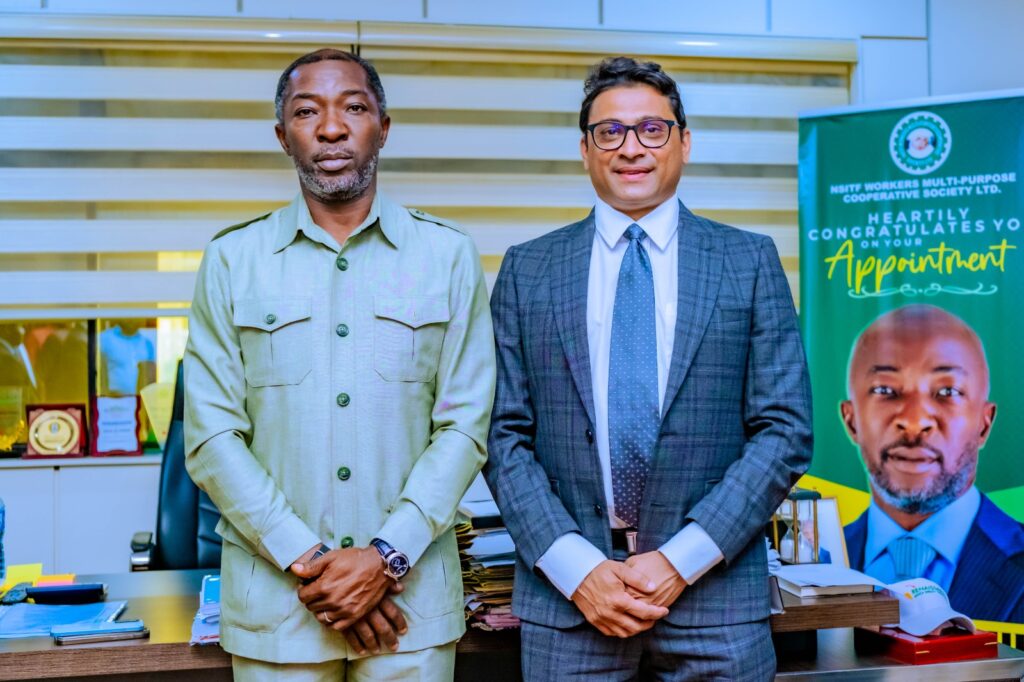
Managing Director and Chief Executive Officer of NSITF, Mr Oluwaseun Faleye, disclosed this on Tuesday while hosting a high-level delegation from RMA at the Fund’s headquarters in Abuja.
The delegation was led by RMA Group Chief Executive Officer, Mr Bilal Adam.
Faleye said the engagement underscored the commitment of both institutions to advancing workers’ compensation, occupational safety and health, and social security administration across the continent.
According to him, the visit marks the beginning of a mutually beneficial and enduring relationship between two leading social insurance institutions in Africa.
“Your visit marks the beginning of what we hope will evolve into a mutually beneficial and enduring relationship between our two organisations,” he said.
Faleye described RMA as an institution with a remarkable legacy, noting that it had established itself as one of Africa’s foremost workers’ compensation and social insurance organisations.
“We are particularly delighted to receive an institution of such remarkable pedigree.
“Established in 1894, Rand Mutual Assurance has built an enviable reputation over more than a century as one of Africa’s foremost workers’ compensation and social insurance institutions,” he said.
The NSITF boss commended RMA’s transformation from a mining compensation scheme into a modern social insurer focused on prevention, rehabilitation, care and value creation.
According to him, collaboration, innovation and knowledge sharing remain critical to the future of social protection and workers’ compensation administration across Africa.
“At NSITF, we recognise that the future of social protection lies in collaboration, innovation and the exchange of experiences.
“Consequently, we view this visit not merely as a courtesy engagement, but as the beginning of a strategic partnership capable of transforming workers’ compensation administration,” he said.
Faleye noted that Nigeria and South Africa, as leading African economies, have a responsibility to provide leadership and champion best practices in social protection.
“Nigeria and South Africa are two of Africa’s leading economies, and our institutions have a unique responsibility to champion best practices that will strengthen social protection systems throughout the continent,” he said.
He said the engagement would provide opportunities for both organisations to compare experiences, identify areas of mutual interest and address emerging workplace challenges.
Faleye expressed optimism about collaboration in digital transformation, claims administration, occupational health and safety, rehabilitation programmes, capacity building, research and policy development.
“I am particularly encouraged by the prospect of collaboration in such areas as digital transformation, claims administration, occupational health and safety, rehabilitation and return-to-work programmes,” he said.
The managing director reaffirmed NSITF’s commitment to strengthening the Employees’ Compensation Scheme (ECS) as a critical social protection mechanism for Nigerian workers.
He said the changing nature of work and emerging occupational risks require social insurance institutions to continuously improve systems and adopt innovative approaches to service delivery.
According to him, the ECS remains one of Nigeria’s most important social security interventions, providing compensation, rehabilitation and support for workers affected by workplace injuries and diseases.
“The Employees’ Compensation Scheme remains one of the most important social security interventions in Nigeria, providing medical care, rehabilitation services and compensation benefits for workers,” he said.
Faleye said NSITF was focused on improving claims administration, occupational safety, rehabilitation services and digital processes to strengthen implementation of the scheme.
“These areas are essential to building a modern and responsive compensation system that protects workers while supporting employers and contributing to national productivity,” he said.
He expressed confidence that a Memorandum of Understanding to be developed and ratified by both organisations would strengthen cooperation and institutional ties.
“Together, let us continue to build stronger institutions, safer workplaces and a more inclusive and resilient social protection system for the benefit of workers across Africa,” Faleye said.
Earlier, Adam said the visit aimed at exploring areas of cooperation in workers’ compensation administration and social insurance development.
The News Agency of Nigeria (NAN) reports that both organisations are expected to hold technical sessions to share experiences and develop frameworks for future collaboration.