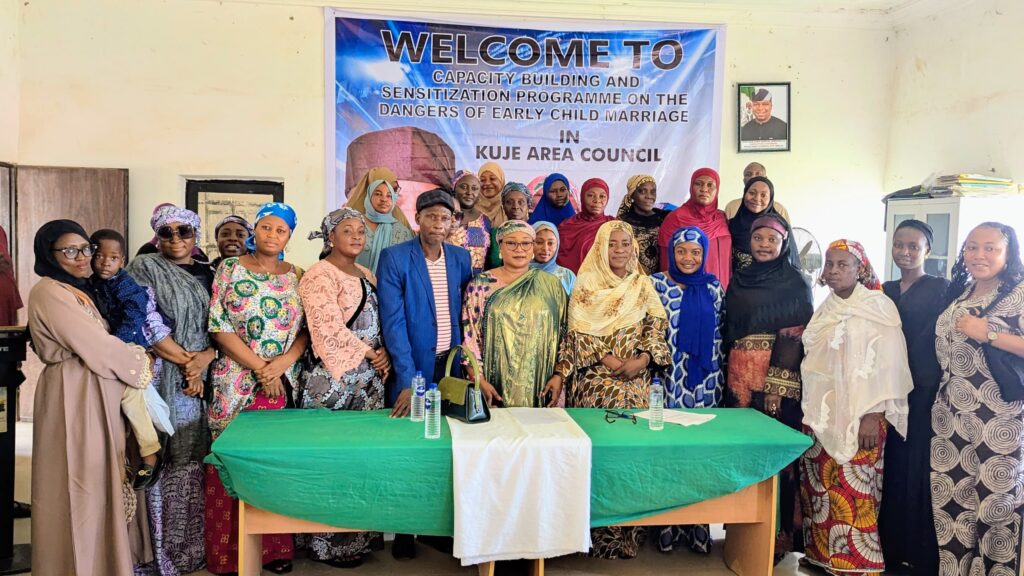
By Gami Tadanyigbe
The Vice Chairperson of Kuje Area Council, Hon. Hajiya Asebe Zainab Boyi, has called for concerted efforts by parents, religious leaders, traditional rulers, teachers, government institutions and other stakeholders to end the practice of early child marriage and safeguard the rights, health and future of the girl-child.
Hon. Hajiya Asebe made the call while delivering her remarks at a programme focused on raising awareness about the dangers and far-reaching consequences of early child marriage in Kuje Area Council.
She expressed deep concern over the continued practice, stressing that marrying off girls before the age of 18 deprives them of critical opportunities to develop, pursue education and achieve their aspirations.
“As a Vice Chairperson and as a mother in this Area Council, I am deeply concerned whenever a girl under the age of 18 is married off. We are not just giving her away; we are taking away her childhood, her education, her health and her dreams.”
According to her, early child marriage exposes girls to a range of challenges, including health complications, school dropout, poverty, psychological trauma and domestic violence, while also limiting their ability to contribute meaningfully to the development of their families and communities.
The Vice Chairperson reaffirmed the commitment of the administration of the Executive Chairman of Kuje Area Council, Hon. Danjuma Samuel Shekwolo, to protecting the rights, welfare and future of every child within the Area Council.
She called on parents and guardians to prioritise the education and well-being of their children, while urging religious and traditional leaders to use their positions of influence to discourage practices that undermine the rights and dignity of the girl-child.
Also speaking, the wife of the Executive Chairman, Mrs. Mary Samuel Shekwolo, described early child marriage as a serious social challenge with far-reaching consequences for the girl-child, her family and the wider community.
Mrs. Shekwolo noted that the practice not only truncates the education and personal development of young girls but also limits their capacity to participate effectively in the socio-economic development of the Area Council.
She urged stakeholders to intensify awareness campaigns and community engagement to address the social, cultural and economic factors that contribute to early child marriage.
In a presentation titled “The Effects of Early Marriage,” a resource person, Dr. Solomon Wogan, described underage marriage as a violation of fundamental human rights, warning that it could result in long-lasting emotional and physical trauma for affected children.
Dr. Wogan stressed the need for stakeholders to strengthen advocacy and collective action against the practice, particularly in communities where the girl-child remains vulnerable to early marriage.
He described early marriage as a global challenge requiring urgent and coordinated intervention.
“It is a global challenge and we must nip it in the bud.”
The programme provided an opportunity for stakeholders to deliberate on practical measures to prevent early child marriage, promote girls’ education and create a safer environment where every child can grow, learn and realise her full potential.
Participants called for sustained community sensitisation, stronger child-protection mechanisms and closer collaboration among government institutions, families, traditional and religious leaders, schools and civil society organisations to eliminate early child marriage in Kuje Area Council.