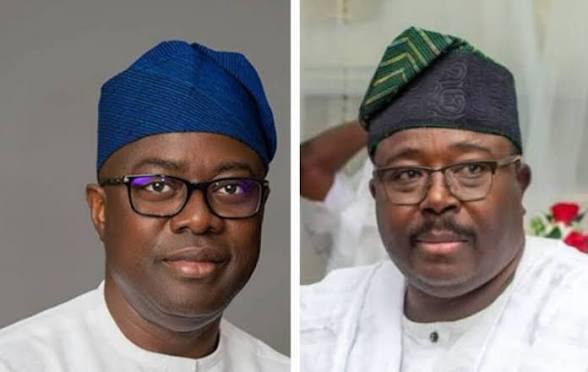
In the theatre of Nigerian politics, public utterances often reveal more about the speaker than the intended target.
Recent remarks by the Oyo State Governor, Seyi Makinde, directed at Senator Sharafadeen Abiodun Alli, serve as a textbook case of political anxiety masquerading as superiority.
By mockingly dismissing Senator Alli as a lawyer who had “never entered a courtroom”, the governor did not just miss the mark; he exposed a profound ignorance regarding how modern leadership, corporate governance, and statecraft actually function.
To measure the value of a legal education solely by the number of briefs argued before a judge is an astonishingly narrow worldview.
History and contemporary reality are replete with individuals who acquired legal training, chose never to practice in a courtroom, and went on to reshape their societies and industries.
Globally, one looks at figures like Vladimir Putin, who studied international law before navigating state intelligence and the presidency, or the legendary tenor Andrea Bocelli, who earned a law degree before conquering the global music industry.
In Africa, mining magnate Patrice Motsepe utilised his legal foundation to build an industrial empire rather than spend a lifetime in chambers. In Nigeria, figures such as Bayo Ogunlesi hold legal credentials but choose to deploy his analytical training to dominate the sectors of power, infrastructure, and global finance.
Our governor should be enlightened that a law degree is not merely a license to litigate; it is a rigorous training in logic, institutional design, and the architecture of regulation.
For Senator Alli to have transitioned from this background into highly impactful roles in administration and governance is not a handicap; it is standard practice among the global elite.
This makes Governor Makinde’s jibe not only elite-blind but deeply ironic when his own professional record is subjected to the same scrutiny.
The governor frequently highlights his background as an engineer. Yet, within the context of public accountability, it is entirely legitimate to challenge him to name the specific engineering firms where he practiced engineering, and to provide a transparent account of how his wealth was generated prior to entering public office.
More importantly, if engineering is the ultimate qualification for governance, the people of Oyo State have a right to ask why this expertise has not translated into solving the state’s persistent power crisis.
We live in an era where the Nigerian power sector has been decentralised, granting state governments unprecedented constitutional powers to generate, transmit, and distribute electricity independently.
Despite this immense legal leverage, the current administration’s energy policies have largely hit a wall when it comes to the welfare of the everyday citizen.
While the government has signed the Oyo State Electricity Regulatory Commission Bill into law and commissioned an 11 Megawatt hybrid power plant in Ibadan, a critical look at the execution reveals a deeply flawed strategy.
This newly generated power is strictly an elite, institutional luxury.
It was designed exclusively to power government facilities—the Governor’s Secretariat, the House of Assembly, and the High Courts.
The ordinary artisan in Bodija, the market woman in Molete, and the business owners across Oyo State are entirely excluded, left to languish under the gridlock of an unstable power supply.
Even the administration’s highly publicised “Light Up Oyo” streetlighting project historically relied heavily on expensive, diesel-powered generator backup systems.
Witnessing an engineer-led government spend billions on diesel haulage to power streetlights, rather than implementing widespread, sustainable solar grids for its populace, represents a monumental failure of technical imagination.
Perhaps the most puzzling aspect of this entire episode is the timeline.
Governor Makinde is not on the ballot for the 2027 Oyo State gubernatorial election, as he is currently serving his second and final term. Why, then, is he launching such fierce campaigns of calumny against Senator Alli?
The intensity of these recent attacks suggests a deeper political calculation. It shows a palpable apprehension within the ruling establishment about the shifting political landscape in Oyo State.
When a departing leader spends valuable political capital trying to diminish an opponent who is actively delivering representation in the Red Chamber, it is rarely a sign of strength.
Ultimately, Governor Makinde’s rhetorical assault on Senator Alli exposes the hazardous limitations of technocratic arrogance in public administration.
Leadership is not defined by the narrow custody of a professional license but by the systemic impact of one’s policies on the populace.
While foundational training in law has historically equipped global innovators and statesmen to build resilient, macro-level institutions, a misapplied background in engineering can easily reduce governance to isolated, expensive vanity projects.