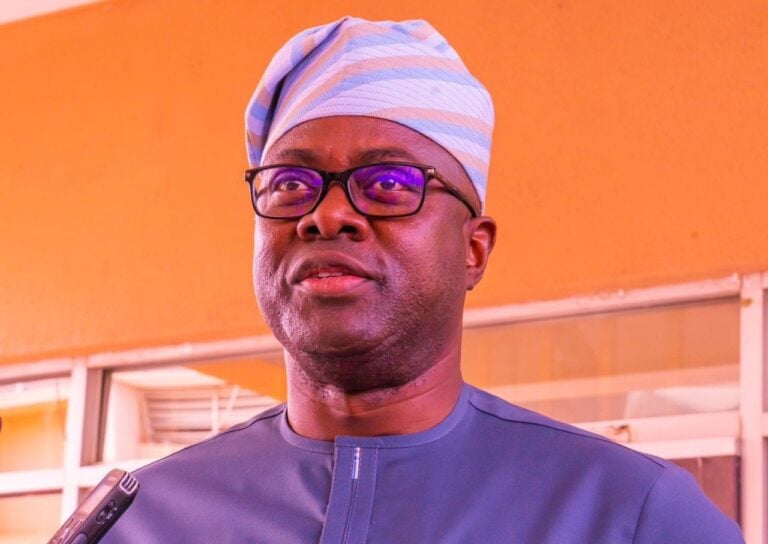
In democratic governance, the measure of a statesman lies in institutional consistency; yet the latest manoeuvres by Seyi Makinde, Governor of Oyo State, lay bare how easily substantive reform is sacrificed on the altar of political hypocrisy and opportunism.
Caught in the throes of an intensive presidential ambition, Governor Seyi Makinde has increasingly resorted to a strategy of systematically de-marketing President Bola Tinubu’s administration.
However, in doing so, he has inadvertently laid bare the pattern of administrative desperation and stark ignorance that characterises his own tenure in Oyo State. The Governor perfectly exemplifies the classic Yoruba proverb, “Èpà ńpa ara rẹ̀, ó ní òun ńp’ajá”—the dog tick destroys itself, yet boasts that it is killing the dog.
Makinde’s recent public condemnation of the newly approved Nigerian Army formations represents the apex of his contradictory politics.
On the national stage, he has sought to undermine the federal government’s defence expansion by weaponising the 2026 budget, declaring the creation of new divisions a planless, unfunded venture. Yet, his criticism completely disregards the foundational realities of executive administration. It is elementary governance that transformative structural overhauls, such as decentralising the military command across four new strategic regions, are complex, multi-year rollouts.
A president routinely utilises emergency contingency allocations, operational reallocations, or mid-year supplementary budgets to finance newly materialised national security imperatives.
For a sitting governor to feign ignorance of these standard legislative mechanisms points to either a worrying lack of institutional knowledge or deliberate political mischief.
The hypocrisy becomes undeniable when juxtaposed with his behaviour at home: whilst lambasting the grand scheme from external podiums, Makinde has simultaneously stepped forward to gleefully welcome the newly approved localised army deployments within Oyo State.
This habit of dodging local accountability while criticising the federal government was fully visible during the tragic kidnapping of pupils and teachers in the Oriire Local Government Area. Rather than taking decisive command of his state’s internal security apparatus, Makinde immediately engaged in a public blame game, deflecting responsibility by remarkably demanding an international United Nations enquiry into a domestic security breach. This extraordinary call not only signalled an alarming lack of confidence in Nigeria’s sovereign institutions, but it also masked his own administration’s systemic failures.
When the victims were ultimately rescued after 56 days in captivity, it was entirely due to the precision and grit of the federal government’s security agencies.
In a bid to regain political control of the narrative, Makinde subsequently inaugurated a domestic Judicial Commission of Inquiry led by retired Justice Mojeed Owoade.
Though the committee has formally presented its report to the governor in late September 2026, the vital findings and actionable recommendations of that panel remain concealed from the public. Safely insulated from transparency, the Governor continues his anti-federal rhetoric while withholding the very truth his citizens deserve to know.
Even our governor’s economic critiques of the presidency follow the same deceptive script. He routinely berates the Tinubu administration for the prevailing economic hardships experienced by everyday citizens, yet he conveniently fails to disclose how Oyo State’s monthly statutory allocations have increased tremendously under the current federal dispensation.
Also, while Makinde loudly advocates for democratic integrity and institutional perfection at the federal level, his domestic record on local governance tells a different story. Back at home, his administration has systematically muscled and throttled the financial and operational autonomy of Local Government Councils across Oyo State. By treating democratically elected council chairmen as mere administrative appendages and dictating their fiscal boundaries, he has crippled grassroots development—the exact tier of governance closest to the hurting populace.
Governor Seyi Makinde’s political trajectory has become a cautionary tale of a leader blinded by the horizon of a presidential election. True statesmanship requires matching national criticism with impeccable local performance.
By relentlessly attacking the federal architecture while orchestrating local government overreach, dodging security accountability, and quietly absorbing inflated federal revenues, Makinde has allowed his national campaign to overshadow his constitutional duties.
Until his governance in Oyo State can match the lofty standards of his rhetoric, his continuous criticisms will remain nothing more than the contradictory noise of a desperate politician out of his depth.