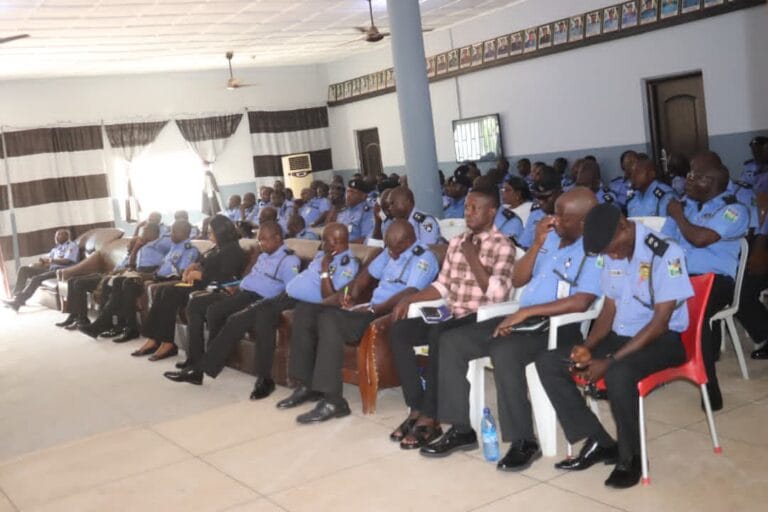
The Niger State Police Command, in collaboration with the Independent National Electoral Commission (INEC), has trained police officers on election security management as part of efforts to ensure a peaceful, safe and credible 2027 general elections.
The training took place on Thursday, October 29, 2026, during the Command’s end-of-month general conference at the Police Officers’ Mess, Dutsen-Kura, Minna, presided over by the Commissioner of Police, CP Adamu Abdullahi Elleman.
The INEC State Training Officer, Dauda Haruna, delivered a lecture titled “Professionalism, Impartiality and Accountability for a Peaceful, Safe and Credible Election,” highlighting the Nigeria Police Force’s leading role in election security management and its position as co-chair of the Inter-Agency Consultative Committee on Election Security (ICCES).
Haruna emphasised the responsibility of the police to provide adequate security for voters, candidates, political party agents and electoral officials throughout the electoral process, noting that professional conduct was essential to protecting electoral integrity, strengthening public confidence and sustaining democratic governance.
He explained that the rules of engagement established through INEC and the ICCES Code require election security personnel to demonstrate professionalism, impartiality, accountability and respect for human rights while ensuring equal treatment of all political stakeholders and avoiding interference in the electoral process.
The INEC official outlined the core responsibilities of police officers during elections to include enforcing electoral laws, responding promptly to incidents, making lawful arrests where necessary, preserving evidence, documenting electoral offences, identifying witnesses and maintaining proper records and chain of custody of evidence.
He also stressed the importance of strict non-partisanship and the protection of all participants in the electoral process in accordance with applicable laws and the principles governing the use of force and firearms.
Addressing public expectations of election security personnel, Haruna underscored the need for effective crowd management, crisis de-escalation, responsible use of force, familiarity with polling-unit layouts and potential security risks, as well as clear communication.
He cautioned officers against provocative conduct, selective or arbitrary arrests and actions based on rumours or unverified allegations.
He further urged them to comply with operational mandates, provide proper security escorts for electoral materials, coordinate with other security agencies, report credible threats promptly and respect the rights and dignity of all lawful participants.
On the handling of electoral materials, Haruna clarified that their inspection and verification remained the responsibility of INEC and its authorised representatives, while police personnel were expected to provide security within their assigned mandates.
He also advised officers to investigate allegations of misconduct professionally and objectively before taking action, ensuring that decisions were based on established facts and applicable laws.
Explaining procedures for managing misconduct at polling units, the INEC training officer said electoral officers were expected, where applicable, to complete the prescribed “Authority to Remove Person from Polling Unit for Misconduct” form, duly signed by the Presiding Officer.
He urged police officers responding to such incidents to de-escalate tensions, listen separately to the parties involved, protect all stakeholders, prevent confrontations between opposing groups, communicate decisions clearly, preserve relevant evidence and submit comprehensive incident reports through the appropriate channels.
The training also covered electoral offences and their corresponding penalties under the Electoral Act 2026, alongside the responsibilities of Election Security Personnel before and after deployment.
Before deployment, officers were advised to attend operational briefings, understand their assignments and chain of command, familiarise themselves with relevant laws and operational orders, account for assigned personnel and equipment, establish appropriate reporting channels and coordinate with other security agencies.
They were also urged to monitor potential security risks and maintain high standards of professionalism, integrity and impartiality throughout their assignments.
After deployment, personnel are expected to participate in debriefings, account for electoral personnel, equipment and materials, submit accurate incident reports, hand over preserved evidence and document operational challenges and lessons learnt to improve future election security operations.
Haruna further highlighted the introduction of Registration Area Centres (RACs) and Super Registration Area Centres (Super RACs) to address delays in the commencement of voting caused by the transportation of electoral materials over long distances.
He explained that the arrangements were designed to facilitate the timely delivery of electoral materials to polling units and ensure that voting commenced within the stipulated period.
He also introduced the Collation Support Result Verification System (CSRVS), a technical support mechanism intended to identify and address errors during the collation of election results, thereby promoting accuracy, transparency and accountability.
The training reinforced the importance of professionalism, impartiality, effective inter-agency collaboration and strict adherence to electoral laws in ensuring peaceful, credible and transparent elections in 2027.
In his remarks, CP Elleman commended the INEC State Training Officer and the Resident Electoral Commissioner (REC) for the collaboration, assuring the commission of the Command’s continued support towards the successful conduct of the general elections.
The commissioner described training and retraining as a core policy of the Nigeria Police Force for strengthening professionalism and improving operational effectiveness.
He disclosed that further training on election security management was ongoing nationwide at the instance of the Nigeria Police Trust Fund (NPTF), adding that a training team would soon visit the Niger State Police Command to further equip personnel for their election security responsibilities.
Reviewing security challenges observed during the month, Elleman directed officers to intensify surveillance patrols to strengthen intelligence gathering and facilitate swift intervention in addressing emerging threats.
He also directed officers to provide adequate security for political campaigns and ensure prompt reporting of such activities to the appropriate authorities.
The Command reiterated its commitment to sustained preparedness, professionalism and responsible conduct by election security personnel before, during and after the 2027 general elections.