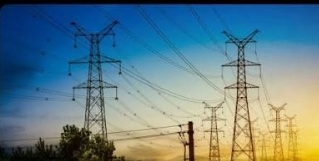
The Federal Government has restored electricity supply to several areas in Lagos, Ogun, Oyo and Kwara states, as well as the Federal Capital Territory, following the repair of a major transmission line damaged by vandals.
The Minister of Power, Joseph Tegbe, announced the development on Monday, saying the repaired Benin-Egbin 330kV transmission line had returned to service and helped raise electricity supply to the Lagos Complex to more than 1,000 megawatts.
He said supply had improved in many affected locations, while efforts were continuing to reconnect areas still experiencing outages.
“I would like to report that power has since been restored to many of the areas earlier affected by power disruptions, largely in Lagos, Ogun, Oyo, Kwara and the FCT. Our teams continue to work to restore full supply to the remaining affected locations,” Tegbe said.
The restoration comes after the Lagos electricity network reportedly lost almost 800MW following the combined impact of maintenance work at Egbin Power Station and the vandalism of the Benin-Egbin transmission line.
The minister explained that the damaged line ordinarily conveys between 300MW and 400MW to the Lagos Complex, making its restoration critical to improving electricity delivery to the commercial centre.
“The vandalised Benin-Egbin 330kV power line has also been swiftly repaired and deployed to transmit power. This restoration helped to bring the total power supply to the Lagos Complex to over 1,000 megawatts, effectively normalising to the condition before the disruption,” he stated.
Beyond the repaired facility, the government is also pursuing the rehabilitation of the Osogbo-Ikeja West 330kV transmission line, which has reportedly been out of service for approximately 18 months.
According to Tegbe, the line could contribute an additional 400MW to Lagos but was damaged after about six transmission towers located in a swampy area were vandalised.
He said the Transmission Company of Nigeria had undertaken to complete the rehabilitation by the end of November, 2026.
The minister noted that Lagos has four major transmission routes, but only three are currently functional, leaving the network with limited alternatives whenever one of the routes experiences disruption.
The recent electricity crisis was also compounded by inadequate gas supplies to some thermal power stations and reduced water inflows into hydroelectric reservoirs.
The Nigerian Independent System Operator had identified these challenges as major factors behind the decline in power generation, explaining that some thermal plants could not operate at their available capacity because of gas shortages.
In a statement last Thursday, the operator said reduced generation had affected electricity allocations to distribution companies, resulting in fewer supply hours and increased load shedding across their networks.
“Consequently, the reduction in available generation has affected the quantum of electricity allocated to Distribution Companies (DisCos) for onward supply to consumers, thereby resulting in reduced hours of electricity supply and increased load shedding across distribution networks,” it stated.
The situation was reflected in the 2,988MW allocated to distribution companies from the 3,840MW generated on the national grid on November 4, 2026.
Tegbe had earlier acknowledged the difficulties faced by electricity consumers, particularly households and businesses in Lagos and Abuja, attributing the supply shortfall partly to scheduled maintenance at Egbin Power Station and gas supply limitations.
“Planned maintenance at Egbin Power Station and constraints in gas supply to some thermal power stations have reduced the amount of electricity available on the national grid. Grid operators have, therefore, implemented load shedding in some areas to manage the shortfall,” he had explained.
He had also indicated that affected generating units would return to operation in phases, with the first expected to resume within 48 to 72 hours.
Meanwhile, persistent electricity challenges have continued to attract criticism from Nigerians and civil society organisations, with some groups demanding the minister’s resignation over what they described as the government’s failure to provide stable electricity.
Although the repair of the Benin-Egbin line is expected to improve supply across Lagos and neighbouring states, inadequate generation, gas shortages, ageing transmission infrastructure, vandalism and distribution challenges remain major obstacles to uninterrupted electricity nationwide.
The minister, however, said the government was working with stakeholders across the electricity value chain to address the challenges.
“Our priority continues to be the provision of reliable electricity to Nigerians,” Tegbe said.