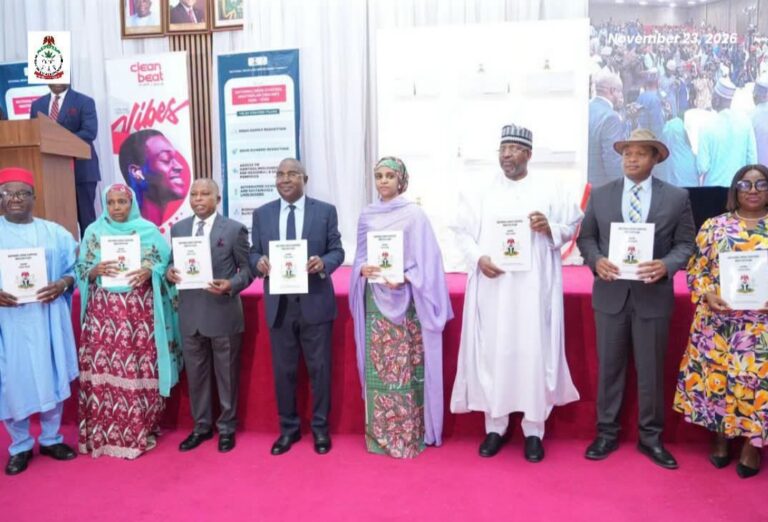
The National Drug Law Enforcement Agency (NDLEA) has unveiled a five-year National Drug Control Master Plan (NDCMP) 2026–2030 aimed at intensifying the fight against drug trafficking, substance abuse, illicit financial flows and emerging drug-related threats in Nigeria.
The plan, themed “Strategic Action for a Drug-Free Nigeria,” was unveiled on Monday in Abuja at an event attended by government officials, lawmakers, diplomats, security agencies, international development partners, civil society organisations and other stakeholders.
Vice President Kashim Shettima, represented by former Minister of the Federal Capital Territory and Special Adviser to the President on Special Duties in the Office of the Vice President, Dr. Aliyu Umar Modibbo, delivered the keynote address and formally unveiled the master plan.
Shettima described drug control as a national priority that should be treated as an emergency, warning that Nigeria could not secure its future without protecting the health, welfare and potential of its citizens, particularly young people.
He said the drug crisis had moved beyond the quantities intercepted by law enforcement agencies, noting that its consequences were increasingly felt in homes, schools, workplaces and communities, with devastating effects on families, productivity, public safety and national development.
According to him, the drug problem must be addressed simultaneously as a public health concern, security threat, development challenge and economic issue, requiring a comprehensive response that combines prevention, treatment, rehabilitation, intelligence-led enforcement and the disruption of criminal financial networks.
The Vice President stressed that enforcement alone would not deliver sustainable results without addressing drug abuse prevention, access to treatment, rehabilitation, vulnerable communities and the financial structures sustaining the illicit drug trade.
He called on federal ministries, departments and agencies, state and local governments, the National Assembly, the justice sector, health and education institutions, security agencies, traditional rulers, religious leaders, civil society and the private sector to take ownership of the plan and ensure its effective implementation.
Earlier, the Attorney General of the Federation and Minister of Justice, Lateef Olasunkanmi Fagbemi, SAN, who served as chief host, said the new master plan represented a renewed national commitment to confronting illicit drug production, trafficking, distribution and abuse through a unified, evidence-based and coordinated strategy.
Fagbemi said drug-related challenges posed serious threats to public health, national security, economic stability and the rule of law, stressing that no single institution could effectively tackle the menace in isolation.
He called for stronger inter-agency collaboration, effective legal frameworks, institutional capacity building and strict adherence to the rule of law, particularly in investigations, prosecution, financial crime tracking and the handling of evidence.
The Attorney General noted that sustainable drug control must go beyond arrests and seizures to include criminal and financial investigations, swift prosecution, accountability and compliance with judicial processes.
He urged stakeholders to draw lessons from the 2021–2025 master plan and ensure that the new framework translated into measurable outcomes and tangible improvements in the lives of Nigerians.
In his welcome address, the Chairman and Chief Executive Officer of NDLEA, Brigadier General Mohamed Buba Marwa said drug control remained one of Nigeria’s most critical national challenges, requiring sustained commitment, stronger partnerships and a whole-of-government approach.
Marwa disclosed that the evaluation of the previous National Drug Control Master Plan, covering 2021 to 2025, recorded 77,300 arrests, seizures of more than 14.8 million kilogrammes of drugs and over 14,200 convictions.
He added that more than 32,400 people benefited from drug demand reduction services, including treatment, counselling and rehabilitation.
According to him, the new plan would consolidate the achievements of the previous framework, address implementation gaps and respond to evolving threats, including synthetic drugs, new psychoactive substances, cyber-enabled trafficking, encrypted communications and cryptocurrency-enabled illicit transactions.
Marwa said drug trafficking networks had become increasingly sophisticated, making it imperative for Nigeria to deepen intelligence-led operations, dismantle criminal networks at leadership level, trace illicit proceeds and strengthen collaboration among law enforcement, financial intelligence, border management and justice institutions.
He cited a recent international operation involving the NDLEA, the United States Drug Enforcement Administration and law enforcement partners from Switzerland, France and Greece, which led to the dismantling of a transnational drug trafficking and money laundering organisation operating across Nigeria and Europe.
The operation, conducted on April 28, 2026, following months of intelligence gathering and investigations, reportedly resulted in the arrest of Nigerian drug baron Amadi Simon in Switzerland, alongside alleged female kingpins Jacinta Amara Ikechi in Anambra State and Blessing Muzi Amagi in Delta State.
The Coordinator of the National Drug Control Master Plan, Mrs Obot Uduak Basil, in her presentation, outlined the six strategic pillars of the 2026–2030 framework, covering drug supply reduction, drug demand reduction, access to controlled medicines, alternative development and sustainable livelihoods, destruction of the illicit drug economy, and coordination and institutional strengthening.
The pillars are designed to strengthen coordinated law enforcement and border surveillance, improve intelligence gathering, expand prevention, treatment and rehabilitation services, ensure access to essential medicines while preventing diversion, promote alternative livelihoods in vulnerable communities and disrupt the financial and social foundations of drug trafficking.
Goodwill messages were delivered by the wife of the Yobe State Governor, the Chairman of the House of Representatives Committee on Narcotics and Drugs Enforcement, Hon. Abbas Adigun, representatives of ECOWAS, international organisations, development partners, members of the diplomatic corps, civil society organisations, government officials and other stakeholders.
The launch of the master plan marks the beginning of a renewed five-year national effort to confront drug trafficking and substance abuse, with stakeholders stressing that its success will depend on effective coordination, sustained funding, institutional accountability and measurable impact across the country.