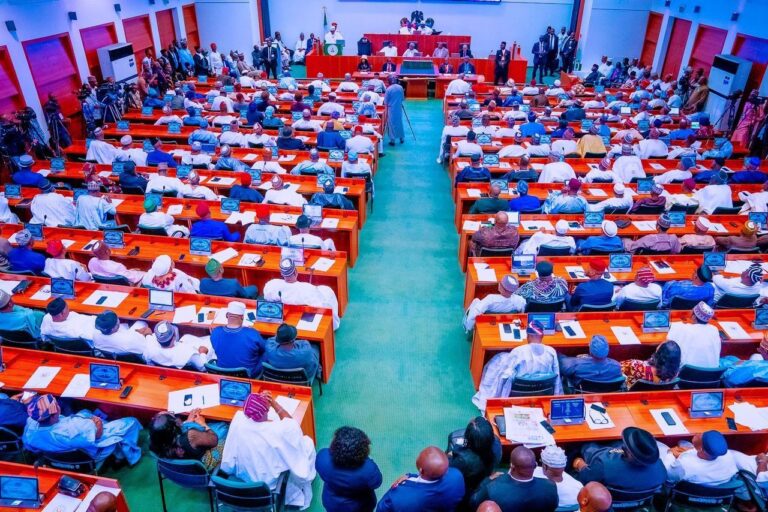
The Senate Tuesday approved the 2026–2028 Medium Term Expenditure Framework (MTEF) and Fiscal Strategy Paper (FSP) submitted by President Bola Tinubu.
The is sequel to the presentation of the 2026 Appropriation Bill to a joint session of the National Assembly.
In approving the framework, the Senate reduced the crude oil benchmark price for 2026 to $60 per barrel, down from the $64.85 earlier proposed by the executive, while fixing benchmarks at $65 and $70 per barrel for 2027 and 2028, respectively.
The Upper Chamber said the adjustment was necessitated by heightened geopolitical tensions in Europe and the Middle East, as well as the volatility of international oil prices.
The approval followed the consideration and adoption of the report of the Senate Committee on Finance, chaired by Senator Sani Musa (APC, Niger East), during plenary.
Under the approved framework, the Senate endorsed a N54.46 trillion federal expenditure plan for 2026, designed to insulate the economy from global shocks. The projected exchange rate was pegged at N1,512/$ for 2026, N1,432.15/$ for 2027, and N1,383.18/$ for 2028, in line with the Central Bank of Nigeria’s policy direction on exchange rate stability.
Inflation is projected to moderate steadily, with rates estimated at 16.5 per cent in 2026, 13 per cent in 2027, and 9 per cent in 2028, reflecting anticipated gains from monetary tightening and structural reforms.
Despite the conservative oil price outlook, the Senate sustained crude oil production projections at 1.84 million barrels per day (mbpd) for 2026, 1.88 mbpd for 2027, and 1.92 mbpd for 2028, expressing confidence in ongoing sector reforms and efforts to stabilise output.
The Senate also retained real GDP growth projections of 4.68 per cent for 2026, 5.96 per cent for 2027, and 7.9 per cent for 2028, citing expected gains from tax reforms and broader economic restructuring.
On fiscal operations, the Senate approved FGN retained revenue of N34.33 trillion, new borrowings of N17.88 trillion, and debt service obligations of N15.52 trillion, resulting in a fiscal deficit of N20.13 trillion for 2026.
The framework provides N1.376 trillion for pensions, gratuities and retirees’ benefits, capital expenditure (exclusive of transfers) of N20.131 trillion, statutory transfers of N3.152 trillion, and a Sinking Fund of N388.54 billion. Total recurrent (non-debt) expenditure was approved at N15.265 trillion, while special intervention funds for recurrent and capital spending were set at N200 billion and N14 billion, respectively.
The Senate endorsed the effective implementation of newly enacted tax laws and approved the introduction of a National Scanning Policy within the National Single Window of the Nigeria Revenue Service, in collaboration with relevant agencies. The policy is expected to enhance revenue assurance, improve trade facilitation, reduce leakages, strengthen transparency, and bolster national security.
[12/17, 9:19 PM] Vincent The nation: Concerned Northern Elders reject NEF position on FIRS, back Tinubu’s reforms
By: Mercy Peter
The Concerned Northern Elders Forum has said that the Northern Elders Forum position on the activities of the Federal Inland Revenue Service (FIRS) and President Bola Tinubu does not represent the thoughts of the region.
The group said NEF position is a misrepresentation of the true aspirations of the North.
They argued that the so-called position of the NEF against the FIRS, its Executive Chairman and the economic reform agenda of President Bola Ahmed Tinubu neither reflects the collective conscience of Northern elders nor aligns with the progressive expectations of the region.
In a press statement signed by Dr Nasir Manguno, the group said it was compelled to address Nigerians in the interest of truth, responsibility and historical accountability.
According to the group, the NEF has lost its moral authority and has gradually transformed from a forum of wisdom into what it described as a platform for political grievances and sponsored opposition narratives.
The elders insisted that leadership and elder statesmanship must be rooted in integrity, foresight and national interest, not nostalgia for failed systems or entitlement to privilege.
The statement praised the performance of the current Executive Chairman of the FIRS, noting that under his leadership, the agency has recorded consistent over-performance of revenue targets, strengthened non-oil revenue mobilisation and deployed technology and data-driven strategies to block historic leakages. It added that the renewed emphasis on fairness and accountability has ensured that influence no longer guarantees exemption from taxation.
The Concerned Northern Elders stressed that these achievements are verifiable and represent what Nigeria can accomplish when competence replaces complacency, arguing that opposition to such reforms is driven by those unsettled by efficiency and transparency.
On the economic reforms of President Bola Tinubu, the group said the administration inherited an economy weakened by subsidy dependency, secrecy and selective compliance.
It commended the President for choosing courage over convenience by pursuing reforms it described as difficult but necessary for national recovery.
They maintained that revenue reform is not punitive but central to nation-building, insisting that no country develops by shielding elites from responsibility or placing the burden of governance solely on the poor.
The group also expressed full support for the Memorandum of Understanding entered into by the FIRS leadership to strengthen inter-agency collaboration, harmonise data systems and eliminate duplication. It argued that any policy framework that promotes transparency, strengthens institutions and enhances revenue efficiency is in the best interest of the North and Nigeria at large.
Addressing what it termed the politics of sabotage, the elders said the renewed criticism of FIRS coincided with political recalibration by opposition interests seeking to weaponise the North against reform. They warned that the region would not allow itself to be used for partisan objectives.
The statement emphasised that the true priorities of the North include job creation, infrastructure development, education and accountability, rather than recycled rhetoric and inherited excuses. According to the elders, these aspirations require strong institutions, fair taxation and fearless leadership.
The group concluded by reaffirming its support for the Executive Chairman of the FIRS, President Tinubu’s economic reform agenda and public servants committed to national interest over elite comfort, stressing that history favours reformers and not obstructionists.
“The North is not against reform. The North is against failure, and it will not be dragged backward by voices sponsored to fear progress,” the statement said.