By Joan Nwagwu
The International Labour Organisation (ILO) has called for the speedy establishment of a National Social Protection Council to strengthen coordination and delivery of social protection programmes in Nigeria.
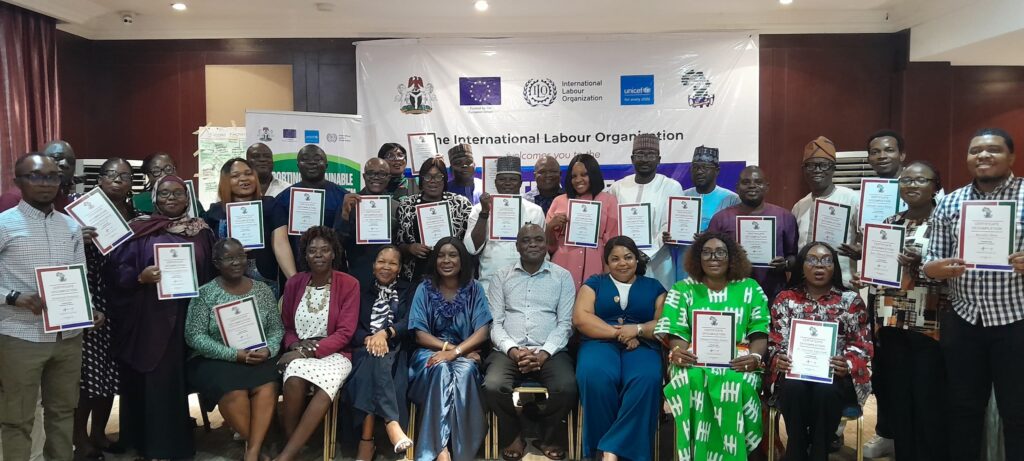
Ms Inviolata Chinyangarara, ILO Senior Specialist on Social Protection, made the call at the end of an eight-day master training on social protection systems in Abuja on Tuesday.
Chinyangarara said the training, organised in collaboration with UNICEF and funded by the European Union (EU), was part of the “Supporting Sustainable Social Protection Systems in Nigeria (SUSPIN)” project.
According to her, the initiative aims to build the capacity of key stakeholders and ensure that social protection programmes are effectively implemented across the country.
She said the training drew participants from Abia, Benue, Oyo and Sokoto States, as well as relevant federal agencies, including the6 Ministries of Labour and Employment, and Humanitarian Affairs.
“This training is not an end in itself. There will be a follow-up to ensure that each master trainer is certified and able to cascade the knowledge to others within their institutions,” she said.
She noted that one of the key innovations of the project was the collaboration among development partners, which replaced the previous silo approach in implementing social protection interventions.
“ILO, UNICEF and the EU are working together to build a strong and sustainable system. We are also touching new geographical areas that have critical needs in social protection,” she added.
Chinyangarara said that the knowledge gained from the training would help states and institutions improve coordination, reduce poverty and strengthen Nigeria’s social protection framework.
Speaking on behalf of the EU, Ms Chioma Osuji, Programme Manager, said the training was part of the EU-funded “Supporting Sustainable Social Protection System in Nigeria (SUSI)” project being implemented by UNICEF and ILO.
According to Osuji, the project has two key components: system strengthening and social safety nets. The system, strengthening component, implemented by UNICEF and ILO, focuses on both national and state levels, particularly in Abia, Benue, Oyo, and Sokoto States.
“The other component, implemented by GIZ, covers the safety nets programme in Borno and Adamawa States,” she said.
According to her, the EU’s funding of the project demonstrates its commitment to supporting Nigeria’s efforts toward inclusive growth, poverty reduction, and sustainable development through effective social protection systems.
She noted that the Abuja training followed a two-day capacity-building session for policymakers and was designed as a master training for stakeholders drawn from federal and state levels.
“The stakeholders are expected to cascade what they have learned to their respective ministries and agencies to ensure the knowledge is institutionalised,” Osuji said.
She added that the EU was pleased that this was the first time Nigeria was developing a pool of master trainers on the Transform Social Protection Model, a key step toward institutionalising social protection training in the country.
“At the end of the day, we expect these master trainers to support their various ministries, agencies, and communities to strengthen social protection systems that will ultimately help reduce poverty in Nigeria,” she said.
Also speaking, Dr Taiwo Benson, National Coordinator of the Network on Social Protection Advocacy in Nigeria (NSPAN), a participant, commended ILO and EU for the training, describing it as timely and transformative.
Benson said the training provided civil society organisations with valuable tools to strengthen collaboration and improve coordination in the fight against poverty.
“One of the key takeaways from this training is the need to work as a team to effectively tackle poverty in Nigeria. Partnership is the new innovation,” he said.
He added that NSPAN and other civil society coalitions were committed to ensuring that Nigeria develops a legal framework to guide social protection and mobilises community voices to hold government accountable for improved funding.
Benson appealed to the Federal Government to fast-track the establishment of the National Social Protection Council through an Act of the National Assembly to enhance coordination and sustainability of social protection efforts.
“As the national social protection policy is being revised, we urge the Federal Government to prioritise setting up the National Social Protection Council as a coordinating mechanism. If we must address poverty in the long term, this structure is crucial,” he said.