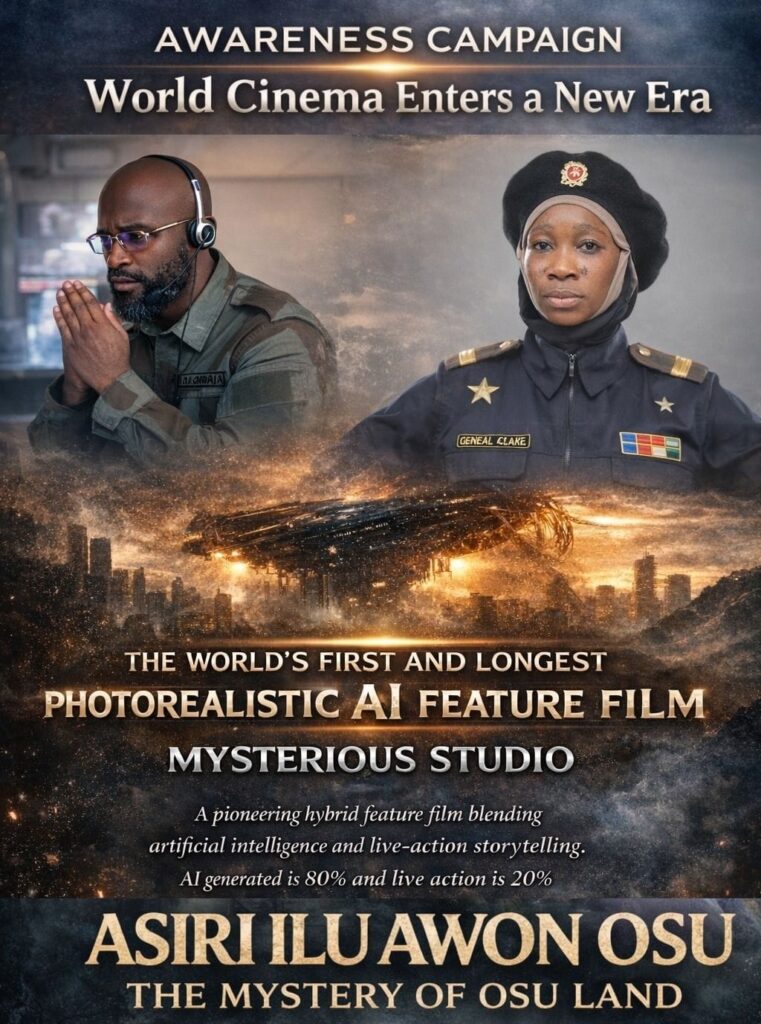
Mysterious Tech Studio, in collaboration with Yoruba Nollywood actress Tanwa Hameed (Asake Omogbajumo), has officially completed the world’s first and longest Yoruba photorealistic feature film co-created by artificial intelligence and live-action filmmaking—a groundbreaking milestone in world cinema.
Titled ASIRI ILU AWON OSU (Mystery of Osu Land), Parts 1 and 2, the film runs over three hours.
It represents a pioneering hybrid cinematic model where approximately 80% of the visuals are generated using artificial intelligence, while 20% comes from live-action performance and human direction.
The project boldly demonstrates how emerging technology can expand the language of filmmaking without erasing human creativity.
Developed between June and September 2025 after three intensive months of production, the Yoruba-language science-fiction feature explores the future of society, power, and humanity through an African cultural lens.
It shows what’s possible when technology is judiciously applied to storytelling, especially in regions often excluded from high-budget cinematic infrastructures.
In October 2025, the filmmakers submitted the project to Guinness World Records under a newly proposed category for the longest cinematic film co-created by artificial intelligence and a human director.
After a three-month title review process, Guinness declined the application on January 27, 2026, stating the category has not yet been formally established—not due to any deficiency in the film itself.
“The title rejection does not change reality,” the filmmakers stated.
“The film exists. It was completed. And it was done first.”
Rather than waiting for institutional validation, Mysterious Tech Studio plans to release the film to the public, critics, researchers, and innovators worldwide—positioning it as a documented world-historical first, with or without formal certification.
The creators emphasize that the project does not aim to replace actors, filmmakers, or traditional cinema. Instead, it shows how AI can serve as a creative tool, particularly for filmmakers in regions with limited access to expensive equipment, large crews, and industrial-scale resources.
By blending human performances, voices, directing, and storytelling with advanced AI-generated visuals, the film proves that innovation and tradition can coexist, opening new pathways for African and global cinema.
The film will soon be available on streaming platforms, allowing audiences worldwide to witness this landmark achievement.