By Ojo Bukola
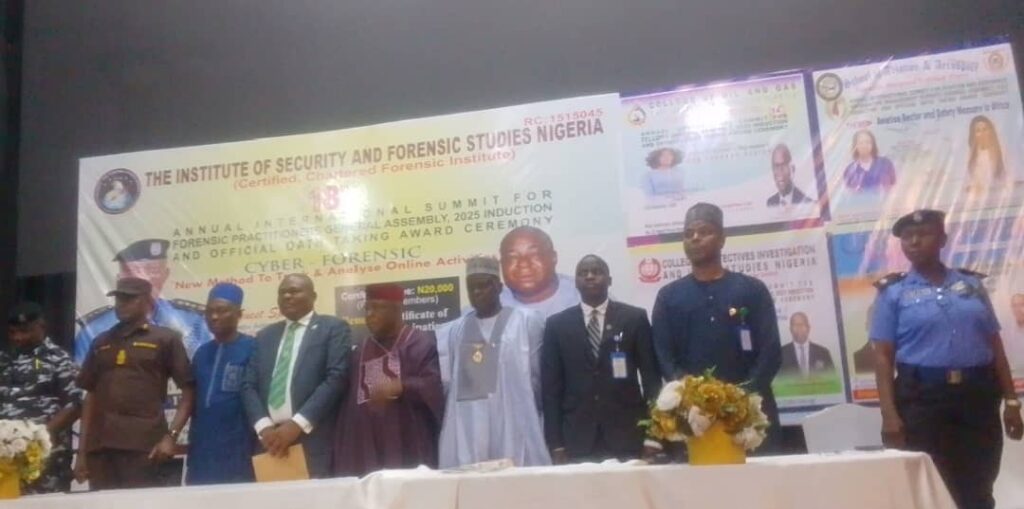
Abuja, Nigeria — The 18th Annual Conference of the Institute of Security and Forensic Studies Nigeria (ISFSN) was held in grand intellectual and ceremonial splendour at the prestigious National Merit Award House, Abuja, a momentous occasion that drew a distinguished convergence of stakeholders from across Nigeria’s security architecture, including forensic experts, intelligence practitioners, policy strategists, academic authorities, and industry leaders.
Anchored on the theme “Cyber-Forensics: New Methods to Track and Analyse Online Activities,” the conference provided a high-level platform for strategic dialogue on the growing complexities of cyber-enabled crime and the urgent need for advanced digital investigative frameworks.
Delivering a keynote address on behalf of the Council of the Institute and its partner institutions, the Director General, Dr. (Amb.) Okocha M. Morgan, described cyber-forensics as the defining frontier of modern security practice, noting that the migration of criminal activities into digital spaces demands sophisticated forensic intelligence, technical competence, and globally compliant methodologies.
Dr. Morgan observed that contemporary security threats now transcend physical boundaries, operating through encrypted networks, digital identities, and online platforms, thereby positioning cyber-forensic expertise at the heart of national security, criminal justice administration, and intelligence operations.
He reaffirmed the Institute’s commitment to remaining a centre of professional excellence, dedicated to producing security and forensic professionals capable of tracking digital footprints, analysing online behavioural patterns, and generating admissible electronic evidence in accordance with international best practices.
The Director General further highlighted the Institute’s expanding interdisciplinary mandate across security and forensic studies, aviation and aerospace information management, detective investigation and legal studies, and oil and gas exploration technology, describing this integrated approach as essential to safeguarding Nigeria’s strategic interests in an increasingly digitised global environment.
Participants at the conference commended the Institute for sustaining eighteen years of institutional leadership in forensic education, intelligence capacity building, and policy advocacy, describing the annual conference as a critical forum for professional networking, policy engagement, and strategic thought leadership.
The conference concluded with renewed calls for stronger institutional synergy, enhanced digital forensic infrastructure, and sustained investment in cybersecurity education as vital measures for confronting evolving cyber threats and strengthening national security.