
If EFCC admits the order means the state of affairs before the dispute, why has Plot 4022, Guzape not been restored — and why is Mrs Rebecca still facing conditions that threaten her life?
For thirteen days, Mrs Rebecca Omokamo Godwin-Isaac says she has remained inside her residence at Plot 4022, Guzape, Abuja, under conditions no Nigerian should be forced to endure.
No water.
No electricity.
No cooking gas.
No ability to cook.
No ability to eat properly.
No peace.
No certainty about her safety.
Since Monday, 29 June 2026, she says operatives of the Economic and Financial Crimes Commission, EFCC, have remained at the property while the basic utilities needed for human dignity and survival have been disconnected.
What is happening now is no longer just a land dispute. It is a human ordeal, a rule-of-law crisis, and a serious threat to her life, health and safety.
EFCC’s Own Filing Defines the Order
EFCC cannot claim not to understand what status quo ante bellum means.
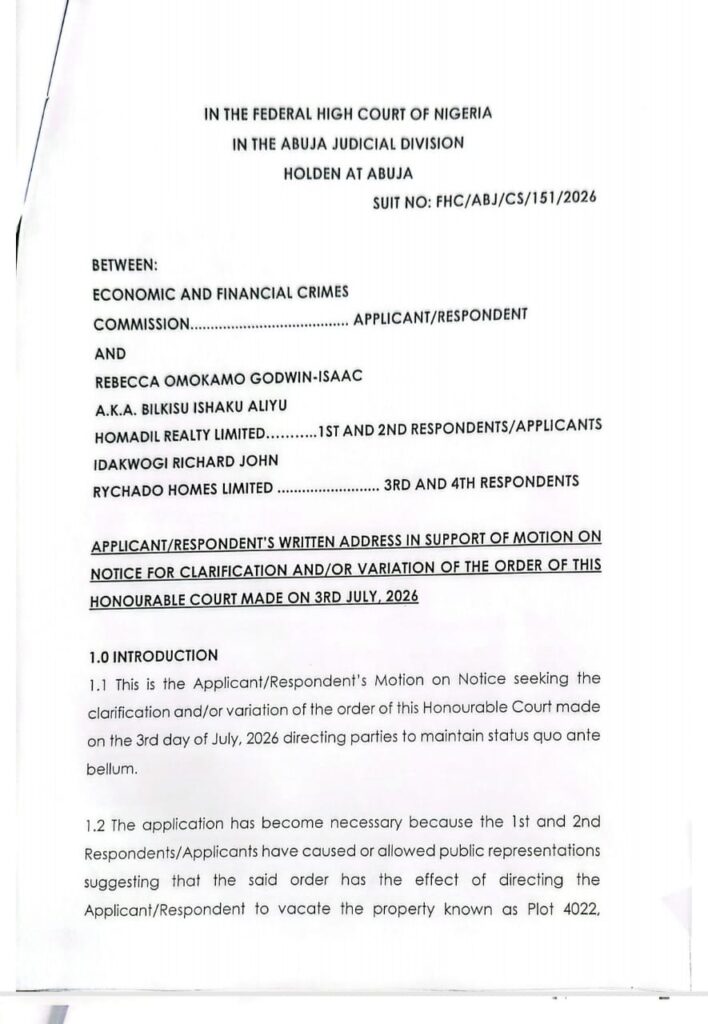
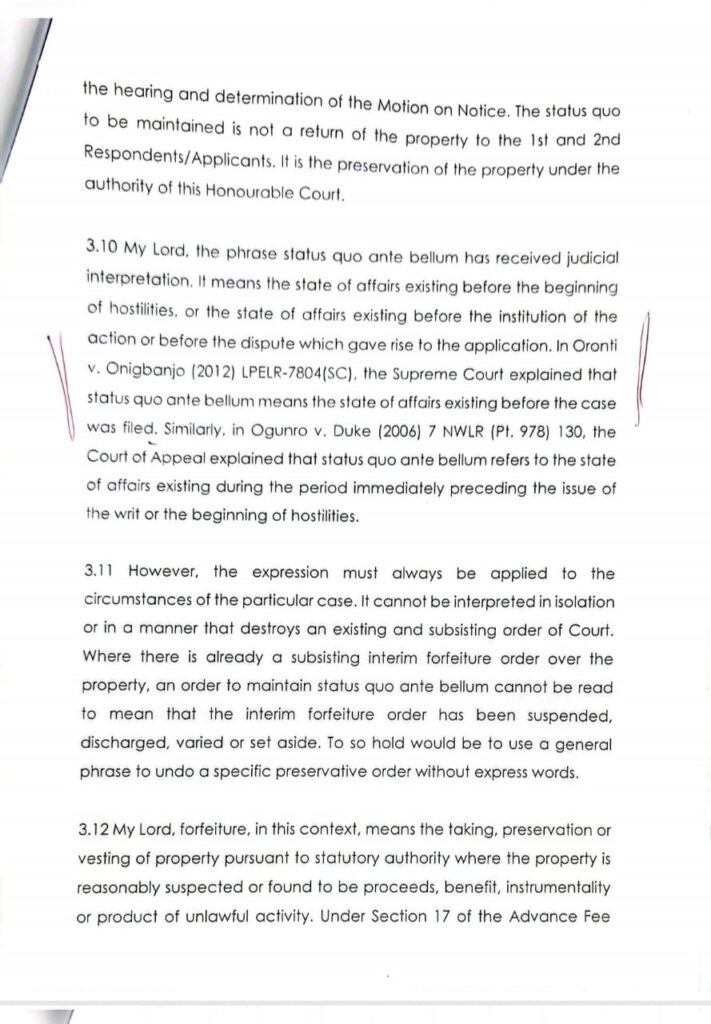
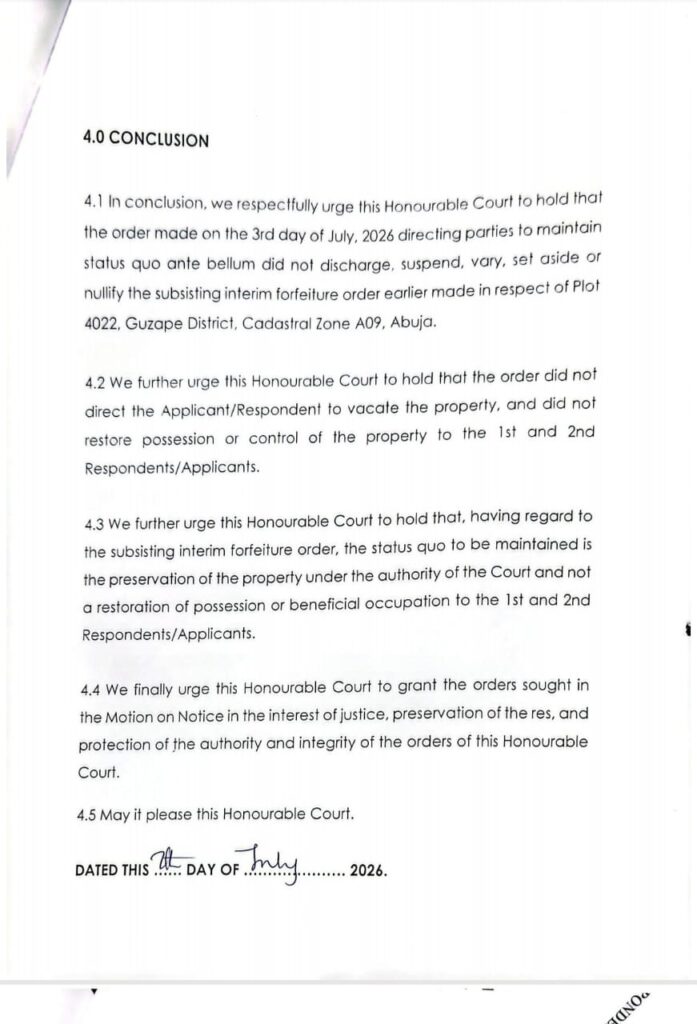
In the Applicant/Respondent’s Written Address in Support of Motion on Notice for Clarification and/or Variation of the Order of this Honourable Court Made on 3rd July, 2026, filed in Suit No. FHC/ABJ/CS/151/2026, EFCC itself addressed the meaning of the phrase.
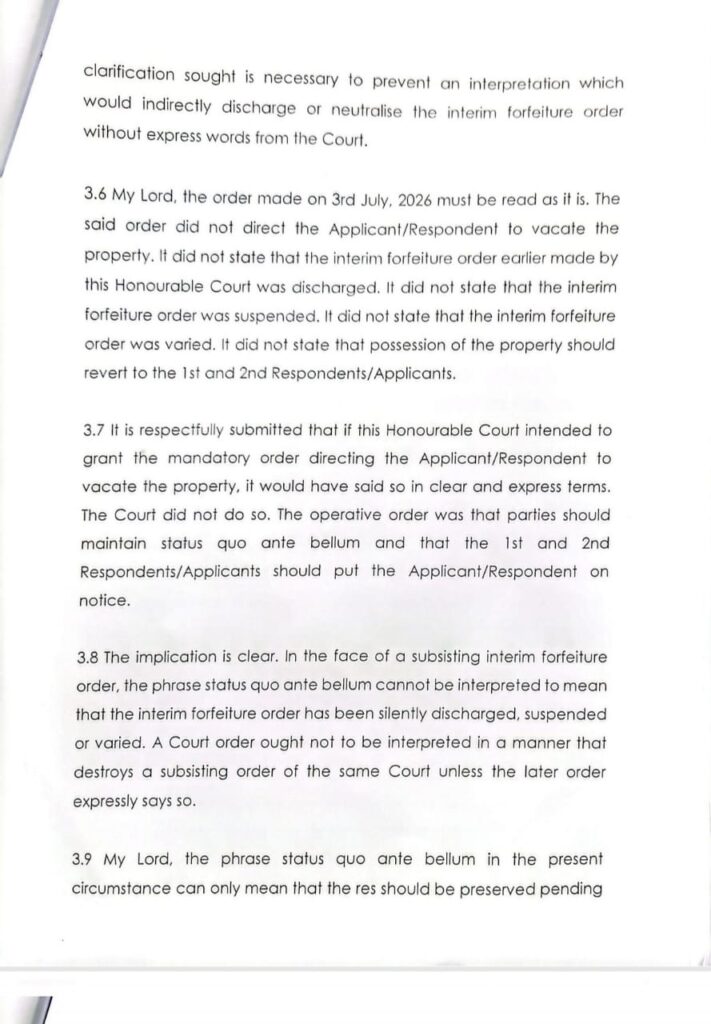
At page 18, paragraph 3.10, EFCC stated that status quo ante bellum means the “state of affairs existing before the beginning of hostilities” and also before the dispute that gave rise to the application.
At page 17, paragraph 3.7, EFCC also admitted that the operative order of the Federal High Court was that parties should “maintain status quo ante bellum.”
That admission is crucial.
Before 29 June 2026, was Mrs Rebecca living without water? Was she living without electricity? Was her cooking gas disconnected? Was she unable to cook or eat properly? Were EFCC operatives stationed inside her residence? Was she living under conditions that threatened her life?
If the answer is no, then the present condition is not the pre-dispute position. It is the condition created after EFCC’s intervention.
The Contradiction EFCC Must Answer
EFCC knows the order. EFCC knows the phrase. EFCC has explained the phrase to the Court.
Yet thirteen days later, Mrs Rebecca says water remains disconnected, electricity remains disconnected, cooking gas remains disconnected, and she remains unable to cook or eat properly in her own home.
This is not just discomfort. It is a serious threat to her health, dignity and life.
A forfeiture proceeding is not a licence to degrade a citizen. A court process is not a licence to starve a woman into submission. Property preservation must never become human punishment.
Forfeiture Must Not Decide Ownership Before the Court Does
Plot 4022, Guzape is the subject of competing claims.
Mrs Rebecca Omokamo Godwin-Isaac asserts her interest in the property. Hajiya Colleen Mero Yesufu also asserts an adverse claim.
That means ownership should be determined by a court of competent jurisdiction, not indirectly decided through pressure, occupation, forfeiture proceedings, or conditions that make the home unsafe and unlivable.
If ownership has not been finally determined, no process should be used in a way that creates a practical transfer of possession, control or advantage before the court decides the real owner.
Forfeiture must not become a shortcut for deciding title.
Thirteen Days Is Not Enforcement
Thirteen days without water is not enforcement.
Thirteen days without electricity is not investigation.
Thirteen days without cooking gas is not preservation.
Thirteen days without the ability to cook or eat properly is not rule of law.
It is cruelty.
It is a threat to life.
Mrs Rebecca has not been convicted of any offence in respect of Plot 4022. The dispute is before a court. The Federal High Court has intervened. Lawyers are making arguments.
Yet the woman at the centre of this ordeal remains without water, electricity, gas and food access.
The court should determine who owns Plot 4022.
Not hunger.
Not darkness.
Not disconnected gas.
Not institutional pressure.
Not conditions that endanger human life.
The Real Pre-Dispute Position Was Simple
Before 29 June 2026, Mrs Rebecca says she was living in her home.
She had water.
She had electricity.
She had cooking gas.
She could cook.
She could eat.
She could sleep in peace.
EFCC operatives were not stationed inside her residence.
That was the pre-dispute position.
Any interpretation of status quo ante bellum that leaves her without water, electricity, gas, food, peace and safety is not a restoration of the pre-dispute position. It is a continuation of the crisis.
The Court Must Not Be Mocked by Conduct on the Ground
A court order is not respected merely by mentioning it in legal papers.
A court order is respected by conduct.
If the Court orders status quo ante bellum, then the reality at Plot 4022 must reflect the pre-dispute position.
The judiciary cannot be reduced to a forum where legal grammar is argued while a citizen remains trapped in darkness, hunger, deprivation and fear for her life.
The Plea Is Simple
Mrs Rebecca Omokamo Godwin-Isaac is not asking to be above the law.
She is asking that the law be obeyed by everyone.
She is asking that EFCC obey the same rule of law it expects citizens to obey.
She is asking that forfeiture not be used to decide ownership before the court determines who truly owns Plot 4022.
She is asking for water.
She is asking for electricity.
She is asking for gas.
She is asking to cook.
She is asking to eat.
She is asking to live.
She is asking to be protected from a situation that now threatens her life.
She is calling on the Inspector-General of Police, the Attorney-General of the Federation, the National Human Rights Commission, the Nigerian Bar Association, human-rights organisations, civil-society groups, women’s rights groups, religious leaders, media organisations and all Nigerians of conscience to urgently come to her aid.
This is no longer only a property dispute. It is now a human emergency.
Restore the water. Restore the electricity. Restore the gas. Let her cook. Let her eat. Respect the Federal High Court. Respect the meaning of status quo ante bellum. Do not use forfeiture to decide ownership before the court. Protect her life.
Because when EFCC’s own filing admits that status quo ante bellum means the state of affairs before the dispute, the public is entitled to ask:
Why is Mrs Rebecca Omokamo Godwin-Isaac still living in the conditions created after the dispute began?
And if the law has spoken, one question remains:
Who is powerful enough to ignore it?