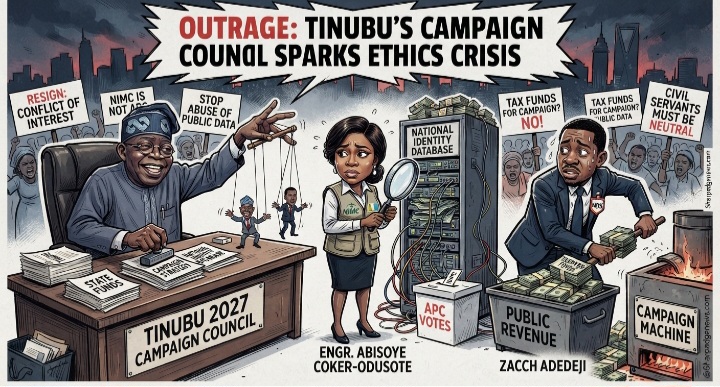
President Bola Tinubu’s newly unveiled 2027 Presidential Campaign Council has plunged his administration into a ethics crisis, drawing fierce condemnation from civil society groups and legal experts over the appointment of key sitting public servants to partisan campaign roles.
At the centre of the growing storm are Engr. Abisoye Coker-Odusote, the Director-General of the National Identity Management Commission (NIMC), and Zacch Adedeji, the Executive Chairman of the Nigeria Revenue Service (NRS).
Both individuals, tasked with safeguarding the nation’s most sensitive citizen data and public revenues, were named to top positions within the All Progressives Congress (APC) campaign machinery, blurring the statutory lines of public service neutrality.
An investigation by Sharpedgenews.com reveals deep anxieties within government circles, with emerging allegations that state infrastructure, national databases, and public funds are already being positioned to favour the president’s reelection bid.
The Data Intersect: NIMC At The Centre
Coker-Odusote’s appointment as the campaign’s Director of Data Management has raised immediate red flags among data privacy advocates. As the head of NIMC, she oversees Nigeria’s national identity database, which houses biometric and personal data for over 100 million citizens.
Sources within the NIMC headquarters in Abuja, speaking to Sharpedgenews.com on the condition of anonymity, revealed that Coker-Odusote has recently deployed external personnel, allegedly brought in from Lagos State, to the commission’s headquarters.
The influx of these unidentified operatives has fueled internal suspicion that parallel data-mining operations may be underway to aid the APC’s 2027 strategy.
“The national database must be a sacred public trust,” said a senior policy analyst at an Abuja-based civil society organisation.
“To have the custodian of that data running the data architecture of a political campaign is a textbook conflict of interest. It compromises the privacy of every Nigerian.”
Funding Questions And The Public Service Rules
The inclusion of NRS Chief Zacch Adedeji has triggered similar alarms regarding fiscal integrity. As Nigeria’s chief tax collector, Adedeji’s presence on a partisan campaign council raises structural concerns about the potential weaponisation of tax enforcement or the diversion of state resources toward political mobilisation.
Constitutional lawyers point out that these appointments directly challenge Nigeria’s Public Service Rules, which mandate strict political neutrality for civil servants and public officers to prevent the abuse of state power during elections.
The Centre for Information Technology and Development (CITAD) and other prominent watchdog groups have formally demanded the immediate resignation of Coker-Odusote and Adedeji from their government posts, arguing that their continuous stay in office erodes public trust in key state institutions.