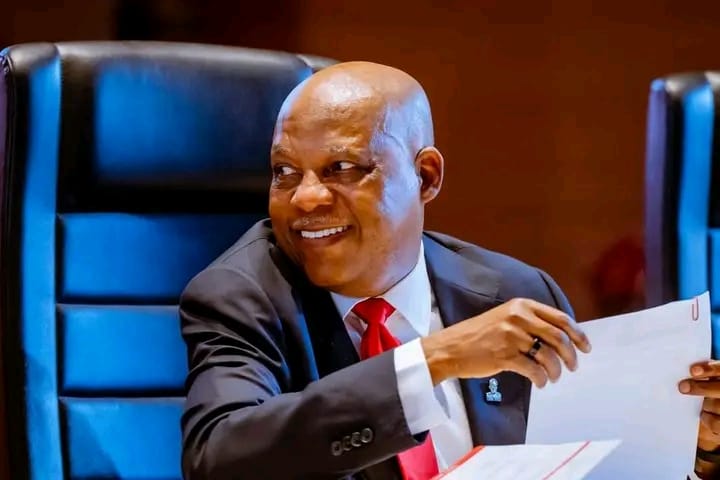
Vice President Kashim Shettima on Wednesday urged state governments to end their reliance on the Federal Government for power solutions and establish functional local electricity markets under the Electricity Act 2023.
Speaking at the National Stakeholders’ Workshop on the Electricity Act 2023 in Abuja, Shettima said Nigeria’s ambition to build a competitive industrial economy would remain constrained unless power sector reforms delivered reliable electricity to businesses, households, and public institutions.
His address was delivered by the Deputy Chief of Staff to the President, Ibrahim Hadejia, at the State House Banquet Hall, Presidential Villa. The workshop was themed “Unlocking the Opportunities of the Electricity Act 2023 for Sustainable Energy Development and Economic Growth in Nigeria.”
Shettima stated that the Act provides a critical opportunity to decentralize power sector governance, allowing states to build markets tailored to their local economies and natural endowments.
”The size, diversity, and endowments of this nation demand this decentralization,” Shettima said. “Electricity supply must become a shared responsibility, pursued with innovation and accountability across the federation. Our states must shed the habit of waiting for Abuja to provide every answer.”
Citing regional resource potential—such as solar energy in Sokoto, Borno, and Katsina; gas reserves in Delta, Rivers, and Bayelsa; and hydroelectric potential in Niger and Kebbi—the Vice President urged governors to translate these assets into viable investments for agriculture, manufacturing, healthcare, and education.
He warned that legislation alone would not improve supply, urging states that have yet to set up electricity regulatory bodies to do so immediately with the requisite technical capacity.
To facilitate seamless transition, Shettima proposed a voluntary National Electricity Reform Peer Review and Implementation Framework. The mechanism—involving the Nigerian Electricity Regulatory Commission (NERC), the Federal Ministry of Power, the Nigeria Governors’ Forum (NGF), and state regulators—would allow states to share best practices, safeguard consumers, and track market development.
”No state needs to purchase with failure the knowledge another state has already acquired,” he noted, adding that government treasury funding alone cannot drive the transformation. “Private capital must arrive with technology and expertise. Transparent licensing, predictable regulation, commercially viable markets, investment safeguards, and credible dispute resolution will earn investors’ confidence.”
State Readiness and Operational Hurdles
Also speaking at the event, Mahmuda Mamman, Permanent Secretary of the Federal Ministry of Power (representing Minister of Power Joseph Tegbe), stressed that the law’s success depends on the states’ ability to build credible institutions and commercially viable markets.
Dr. Abdulateef Shittu, Director-General of the Nigeria Governors’ Forum, revealed that work is underway on a standard tariff framework designed to protect consumers while attracting private investment.
Hauwa Yakubu, Head of Compliance at the Electricity Commission, reported that regulatory oversight has already been transferred to 17 states, with Akwa Ibom being the latest. The commission’s order transferring intrastate regulation to the Akwa Ibom State Electricity Regulatory Commission (AKSERC) was dated August 18, 2026, with full transition scheduled for completion by February 17, 2027. Sixteen other states completed their full transition in July.
Signed into law by President Bola Tinubu in June 2023 to replace the Electricity Power Sector Reform Act of 2005, the Electricity Act empowers states to license intrastate generation, transmission, and distribution, while federal regulators retain oversight over interstate operations. States such as Lagos, Edo, and Kaduna had already enacted local electricity laws prior to the national legislation.
Despite the regulatory progress, the power sector continues to face severe financial strain. Generation companies reported in March that outstanding debts stood at approximately ₦6.8 trillion at the end of February, while national output remains stalled at around 4,000 megawatts despite an installed grid capacity of 14,000 megawatts.