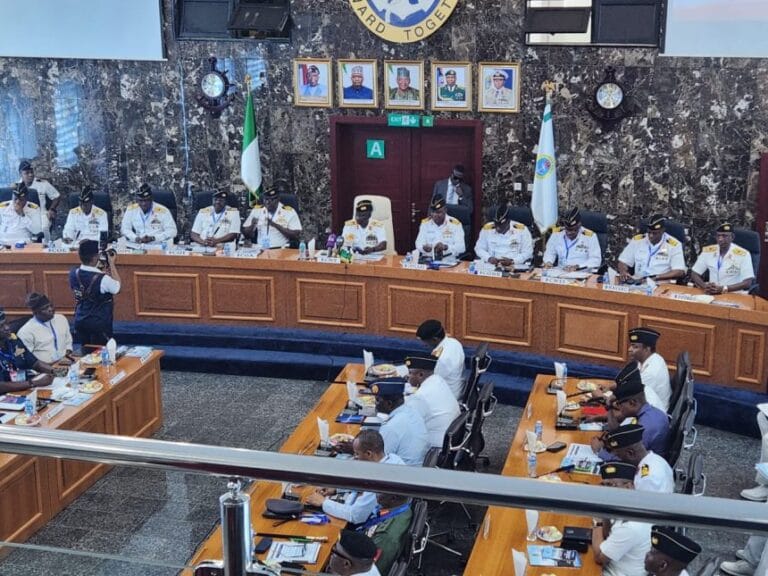
The Chief of the Naval Staff (CNS), Vice Admiral Idi Abbas, has challenged research experts to develop practical technological solutions that will enhance the Nigerian Navy’s operational effectiveness, strengthen maritime security and reduce the country’s dependence on foreign technology.
Abbas gave the charge while delivering the keynote address at the Nigerian Navy Research and Development Seminar 2026, themed “Deepening the Application of Emerging Technologies for Operational Effectiveness.”
He stressed that research and development must go beyond theoretical innovations to produce affordable, locally developed solutions capable of addressing the Navy’s operational challenges and improving national security.
The Naval Chief noted that Nigeria’s maritime security environment was becoming increasingly complex, with criminal networks exploiting technological advancements to evade detection and threaten critical national assets.
He explained that addressing these threats required timely intelligence, accurate surveillance and the capacity to deploy naval assets effectively to areas where they were most needed.
According to him, the objective is not simply to acquire more technology but to achieve better operational outcomes with available resources.
Abbas also highlighted the importance of technological innovation in counterterrorism and counterinsurgency operations, noting that Nigerian Navy personnel, including Marines and Special Forces, were increasingly involved in joint military operations.
He identified unmanned surveillance systems, secure communications, improved intelligence gathering and enhanced battlefield awareness as critical capabilities for strengthening operational coordination, protecting personnel and advancing national security.
The CNS further pointed to indigenous shipbuilding and maintenance as evidence of the Navy’s growing capacity to develop and sustain operational capabilities locally.
He disclosed that his strategic direction included establishing research and development cells at command level and creating the Nigerian Navy Research Institute to institutionalise innovation and transform research findings into affordable, operationally relevant solutions.
Abbas called for stronger partnerships between the Nigerian Navy, universities, research institutions and indigenous industries, urged participants to identify capability gaps, recommend viable research collaborations and develop practical approaches to deploying locally developed technologies.
He expressed appreciation to President Bola Ahmed Tinubu for his continued support and commended the Naval Transformation and Innovation Branch for organising the seminar.
Earlier, the Chief of Transformation and Innovation, Naval Headquarters, Rear Admiral Chijioke Onyemaobi, said the seminar aligned with the CNS’s vision of harnessing emerging technologies, strengthening research and development, and promoting indigenous solutions to improve naval operational capabilities.
Onyemaobi commended Abbas for approving the seminar and attending despite his demanding schedule, describing his presence as a demonstration of the Navy’s commitment to innovation and technological self-reliance.
He observed that emerging technologies, including unmanned systems, artificial intelligence, advanced sensors and additive manufacturing, were transforming naval warfare, fleet maintenance and equipment sustainment.
He warned that the rising cost of imported platforms and spare parts, coupled with lengthy supply lead times, made the development of domestic technological capacity increasingly important for maintaining operational readiness.
According to him, research and development provides the critical link between emerging technologies and the Navy’s operational requirements, offering a pathway towards reducing technological dependence and achieving greater self-reliance.
He urged participants to share knowledge and professional experiences, emphasising that the seminar should produce practical and sustainable recommendations capable of addressing the Navy’s immediate and long-term operational needs.
The two-day seminar features presentations by invited experts and interactive discussions on emerging technologies, alongside presentations on the research and development activities of Naval Dockyard Limited, Naval Shipyard Limited and the Nigerian Navy Institute of Technology, Sapele.
The sessions are expected to promote collaboration, identify promising indigenous innovations and strengthen the relationship between research institutions and operational units.
The seminar forms part of the Nigerian Navy’s broader efforts to build a technologically advanced, efficient and self-reliant force through innovation, strategic partnerships and locally developed solutions.
Abbas maintained that the success of these efforts would ultimately be measured not by the number of technologies acquired but by the operational capabilities delivered, resources conserved and tangible improvements achieved in protecting Nigeria’s maritime interests and national security.