By Gami Tadanyigbe
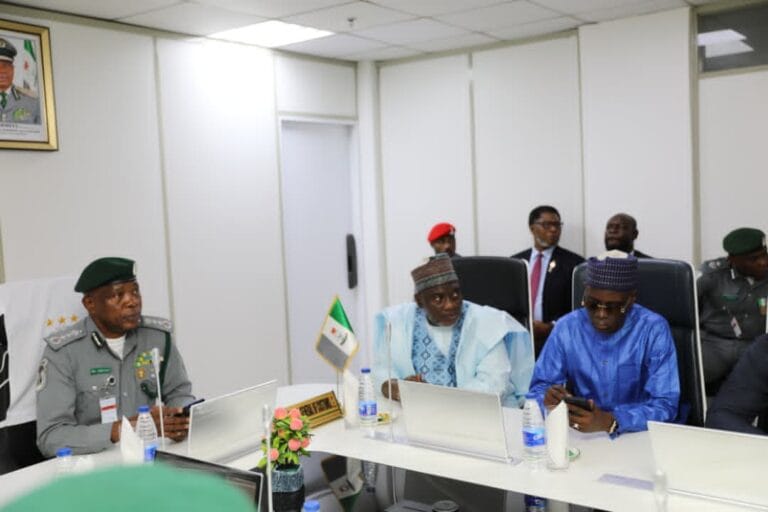
The Nigeria Customs Service (NCS) has showcased its sweeping digital transformation and modernisation efforts to the Senate Committee on Customs, Excise and Tariff during a two-day retreat, highlighting how technology is strengthening revenue generation, border security, and trade facilitation.
The retreat, chaired by Senator Jibrin Isah, ended with an extensive inspection of the Service’s Information and Communication Technology (ICT) infrastructure and operational facilities at the Customs Headquarters in Abuja.
The engagement provided lawmakers with firsthand insight into the NCS’s ongoing reforms, particularly the deployment of advanced digital solutions designed to improve operational efficiency, curb revenue leakages, and enhance border management.
The first day of the retreat featured discussions between members of the Senate Committee and the management of the NCS on policy frameworks, institutional reforms, and the implementation of the Service’s 20-year Customs Modernisation Project.
Comptroller-General of Customs, Bashir Adewale Adeniyi, reaffirmed the Service’s commitment to innovation, assuring lawmakers that sustainability and maintenance mechanisms had been incorporated into the concession agreement to guarantee long-term operational efficiency.
Members of the Senate Committee stressed the importance of sustained legislative oversight, adequate funding, and stronger inter-agency collaboration to consolidate the gains recorded through the reforms.
On the second day, the lawmakers were taken on a guided tour of the Service’s modernisation infrastructure, where the Comptroller-General demonstrated the central role of technology in Customs operations.
Adeniyi explained that the ICT infrastructure at the headquarters mirrors similar digital deployments across Customs commands nationwide, adding that women have played vital roles in designing, deploying, and managing many of the Service’s technological innovations.
A major highlight of the visit was the Command and Control Centre, a centralised digital hub that enables real-time monitoring of cargo movement across Nigeria’s ports.
Officials demonstrated how live feeds from Apapa Port are transmitted to the headquarters, allowing analysts to identify anomalies and provide immediate feedback to officers on the field. They revealed that the system currently supports a 100 per cent cargo scanning regime at Apapa, with scanners capable of processing up to 200 containers every hour.
The lawmakers also inspected the Management Information System (MIS), described by officials as the Service’s “single source of truth,” integrating data on personnel, administration, welfare, and operations.
According to Customs officials, the automated platform has significantly reduced manual processes by digitising leave management, staff training, performance evaluation, and other administrative functions.
The delegation was equally introduced to the Service’s advanced cargo scanning technology, which detects concealed goods, declaration discrepancies, and irregular cargo patterns through colour coding and material classification.
Officials explained that the technology has improved revenue protection, reduced leakages, enhanced transparency, and eliminated opportunities for document manipulation through seamless integration with Customs documentation processes.
The NCS disclosed that six cargo scanners have already been deployed nationwide, while plans are underway to install an additional 22 scanners before the end of the year as part of its transition to a risk-based inspection model that will reduce physical examinations and increase cargo scanning rates.
The Service also showcased its Electronic Currency Declaration System, which allows travellers carrying more than 10,000 US dollars to declare their funds online before arrival or departure, thereby improving compliance, reducing delays, and strengthening inter-agency coordination at Nigeria’s borders.
Chairman of the Senate Committee on Customs, Excise and Tariff, Senator Jibrin Isah, described the retreat as highly enlightening, noting that it exposed lawmakers to the significant technological transformation taking place within the Service.
He said many senators were previously unaware of the extent of the reforms, adding that participants were leaving the retreat as ambassadors of the Nigeria Customs Service.
According to him, technology has become the backbone of Customs operations, significantly improving revenue generation, trade facilitation, and efforts to block revenue leakages.
He also commended President Bola Ahmed Tinubu for providing the necessary policy support and funding that have enabled the Service to implement its ambitious modernisation agenda.
Responding to questions, Comptroller-General Adeniyi reiterated that technology would remain at the heart of Customs operations.
He disclosed that the Service is expanding the use of geospatial intelligence tools to strengthen border patrol operations while introducing virtual shooting range technology to modernise enforcement training.
Adeniyi added that the Customs modernisation programme is firmly backed by the Nigeria Customs Act, which mandates the adoption of technology in the Service’s operations.
He expressed confidence that with sustained government support, the NCS would continue leveraging digital innovation to address increasingly complex operational challenges while improving service delivery.
The retreat concluded with both the Senate Committee and the Nigeria Customs Service reaffirming their commitment to strengthening collaboration in advancing Customs reforms and modernising border management across the country.