By Jacinta Nwachukwu
Plan International Nigeria has reviewed the achievements of a two-year initiative supporting teachers’ welfare, professional development and psychosocial well-being in crisis-affected communities in Sokoto and Adamawa States.
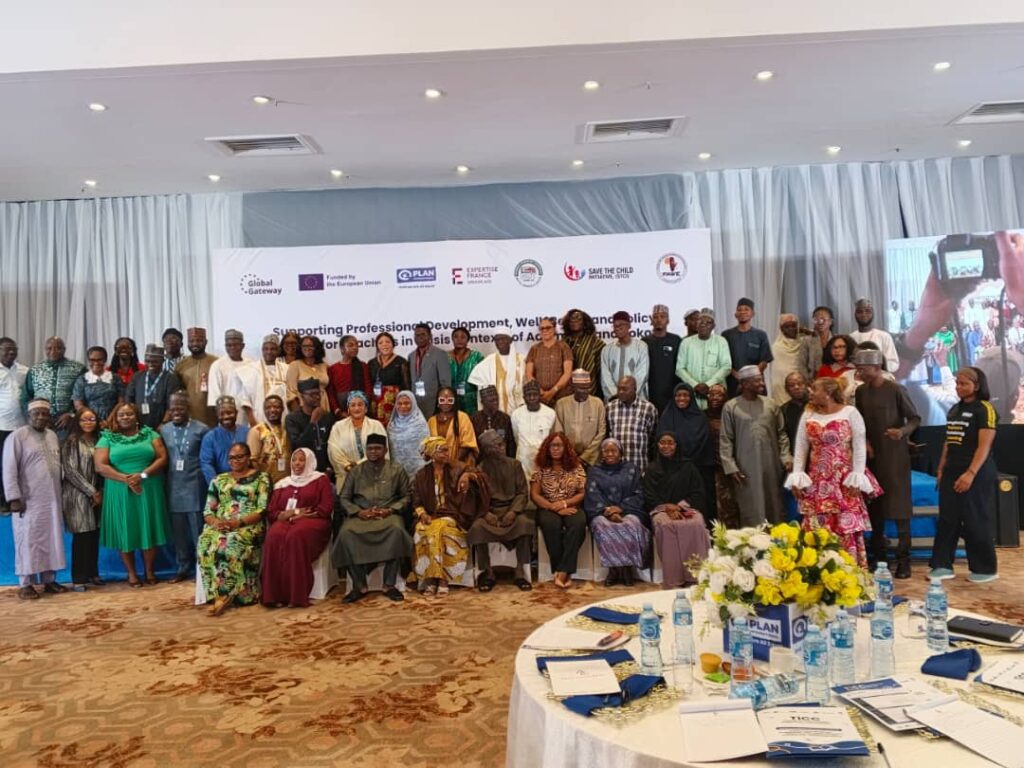
The review took place at the close-out ceremony of the Teachers in Crisis Contexts (TiCC) project in Abuja.
The News Agency of Nigeria (NAN) reports that the project, titled “Building Resilient Education Systems: Supporting Teachers’ Professional Development, Well-being and Policy Reforms in Crisis-Affected Contexts,” was funded by the European Union.
It was also implemented by Save the Child Initiative (STCI) and the Forum for African Women Educationalists (FAWE), in collaboration with the Nigeria Union of Teachers (NUT).
The project is expected to provide a foundation for continued efforts to strengthen teacher support and build resilient education systems in crisis-affected communities.
Speaking at the event, the Country Director of Plan International Nigeria, Dr Charles Usie, said the initiative was designed to strengthen teachers’ capacity, welfare and integration into communities affected by crises.
Usie said the project supported teacher training, provision of equipment and integration into schools, particularly in areas affected by insecurity.
He identified the return of teachers to schools after attacks as one of the major challenges encountered during implementation.
According to him, many teachers become traumatised after attacks on schools and other public institutions, making it difficult for them to return to duty.
“Schools and health centres are usually the first institutions attacked during a crisis. When that happens, teachers run for safety. Most of them are traumatised and don’t want to go back,” he said.
Usie noted that the project had developed a model that could be replicated in other parts of the country.
He commended STCI for its contribution to the implementation, describing the organisation as a committed partner in humanitarian and development work.
He, however, stressed that while development partners could support pilot initiatives, governments have the responsibility to sustain achievements through policies, funding and institutional support.
In his remarks, the Commissioner for Basic and Secondary Education in Sokoto State, Prof. Ahmad Ala, reaffirmed the state’s commitment to strengthening teachers’ professional development, well-being and capacity building.
Ala said sustained investment in teachers was essential to improving education quality and learning outcomes.
NAN also reports that STCI was presented with a certificate of participation in recognition of its contribution.
The close-out activities, held from Oct. 19 to Oct. 22, brought together education stakeholders from Sokoto and Adamawa States to assess achievements, challenges and lessons learned.
Participants included Commissioners for Education from the two states, representatives of the Nigeria Union of Teachers (NUT), Teachers Registration Council of Nigeria (TRCN), Universal Basic Education Commission (UBEC), Plan International Nigeria, FAWE and STCI.
Stakeholders also developed a Sustainability Action Plan to guide continuation and possible expansion of key interventions beyond the project period.(NAN)(www.nanews.ng)