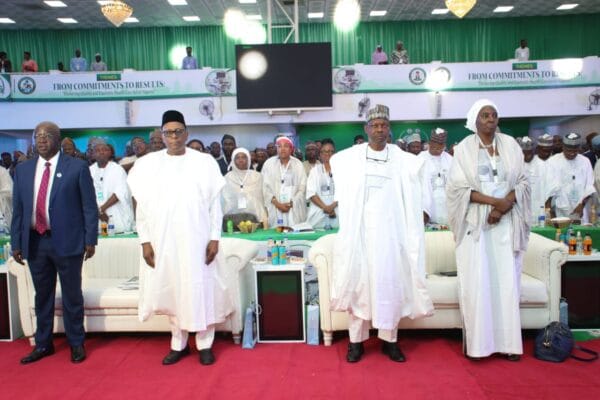
The Coordinating Minister of Health and Social Welfare, Professor Muhammad Ali Pate, has urged state governments to strengthen accountability, improve health sector financing and accelerate the implementation of reforms to translate policy commitments into better healthcare delivery.
Pate made the call on Thursday November 19, 2026 while delivering the keynote address at the 67th National Council on Health (NCH) in Lafia, Nasarawa State, with the theme, “From Commitments to Results.”
He reaffirmed President Bola Tinubu’s commitment to prioritising the health and well-being of Nigerians under the Renewed Hope Agenda.
The Minister disclosed that Nigeria had achieved 41 health sector commitments under the Health Sector Renewal Investment Initiative, while 12 of the 13 monitored health indicators recorded improvements over the last three years.
He said skilled deliveries in facilities supported by the Basic Health Care Provision Fund (BHCPF) increased from 4.8 million in 2023 to nearly eight million by mid-2026, while fourth antenatal care visits rose to 8.7 million.
On healthcare workforce development, Pate said nearly 20,000 skilled birth attendants had been recruited across 22 states, about 5,000 community health workers engaged in 10 states, while almost 80,000 frontline health workers had received retraining through federal and state interventions.
He also disclosed that health insurance coverage had expanded from 16 million to nearly 24 million Nigerians, while the Free Emergency Obstetric Care Programme had supported more than 80,000 caesarean sections.
The Minister added that over 100 million children had been vaccinated against measles and rubella, while more than 17 million adolescent girls had received the Human Papillomavirus (HPV) vaccine.
On local manufacturing and domestic financing, Pate said 10 pharmaceutical and medical production facilities had been commissioned, while state health budgets increased from ₦1.97 trillion in 2023 to more than ₦3.3 trillion in 2026.
He urged state governments to sustain increased investments in healthcare and ensure timely release of appropriated funds.
However, the minister expressed concern over gaps in the implementation of resolutions adopted at previous National Councils on Health.
He revealed that only 412 of the 740 expected implementation reports were received, representing 56 per cent, while no state submitted reports covering all 20 resolutions adopted at the 66th Council in Calabar.
Pate consequently directed states to strengthen monitoring mechanisms, assign clear responsibilities and timelines, and submit quarterly implementation reports through the Council’s resolutions dashboard.
He also called for improved primary healthcare services, stronger digital health systems, expanded mental health services and deliberate efforts to address inequalities in access to healthcare, particularly among rural communities and vulnerable populations.
Looking ahead, Pate said 2027 would be the final year of the Health Sector Strategic Blueprint, while the Council would consider proposals for reviewing the National Health Act 2014.
He urged members to adopt only resolutions they were prepared to fund and implement, insisting that Council decisions must be reflected in state budgets and operational plans.
The Minister also paid tribute to the Permanent Secretary of the Federal Ministry of Health and Social Welfare, Daju Kachollom, for coordinating four successive National Councils on Health in Ekiti, Maiduguri, Calabar and Lafia ahead of her retirement from the public service.
In his opening remarks, the Minister of State for Health and Social Welfare, Dr Iziaq Adekunle Salako, also called on federal and state governments to strengthen accountability and ensure that health sector policies produce measurable improvements.
Salako said previous engagements in 2024 and 2025 had laid the foundation for a unified approach to health reforms, adding that the priority should now be closing the gap between policy commitments and actual service delivery, particularly at the grassroots.
He identified the revitalisation of primary healthcare centres, expanded health insurance coverage, recruitment and training of frontline workers, improved infrastructure, digital health advancement and local pharmaceutical manufacturing as areas recording progress.
Salako further called for increased healthcare investment towards the 15 per cent Abuja Declaration target and urged states with low antenatal care coverage or rising numbers of zero-dose children to develop costed recovery plans in their 2027 operational budgets.
Declaring the 67th National Council on Health open, Nasarawa State Governor Abdullahi Sule said healthcare delivery went beyond constructing hospitals, procuring medical equipment and providing medicines.
Represented by his deputy, Dr Emmanuel Akabe, the governor said healthcare was fundamentally about preserving lives, protecting human dignity and creating opportunities for citizens to live healthy and productive lives.
He said the transition had enabled the state to upgrade the General Hospital in Wamba to a specialist hospital, improving access to advanced healthcare services across the state’s senatorial zones.
The governor further announced the establishment of the Nasarawa State Drugs and Supplies Management Agency to strengthen the procurement and distribution of medical commodities, address price discrepancies and ensure access to quality medicines.
He reaffirmed his administration’s commitment to improving healthcare financing, infrastructure, workforce development and collaboration with federal and local governments, development partners and communities.
Earlier, the Nasarawa State Commissioner for Health, Dr Gwamna Gaza, said the state had recorded significant investments in healthcare infrastructure and service delivery across primary, secondary and tertiary healthcare levels.
Gaza disclosed that health insurance enrolment in the state had increased from zero in 2019 to nearly 300,000, representing approximately 8.5 per cent of the state’s population.
He said the progress had strengthened access to healthcare and financial protection for residents.
The commissioner welcomed delegates to Lafia, noting that the unanimous decision to select Nasarawa as host of the 67th National Council on Health at the previous meeting in Calabar reflected confidence in the state’s capacity to host the gathering.
The annual council brings together federal and state health authorities and other stakeholders to deliberate on policies, challenges and strategies for improving healthcare delivery in Nigeria.