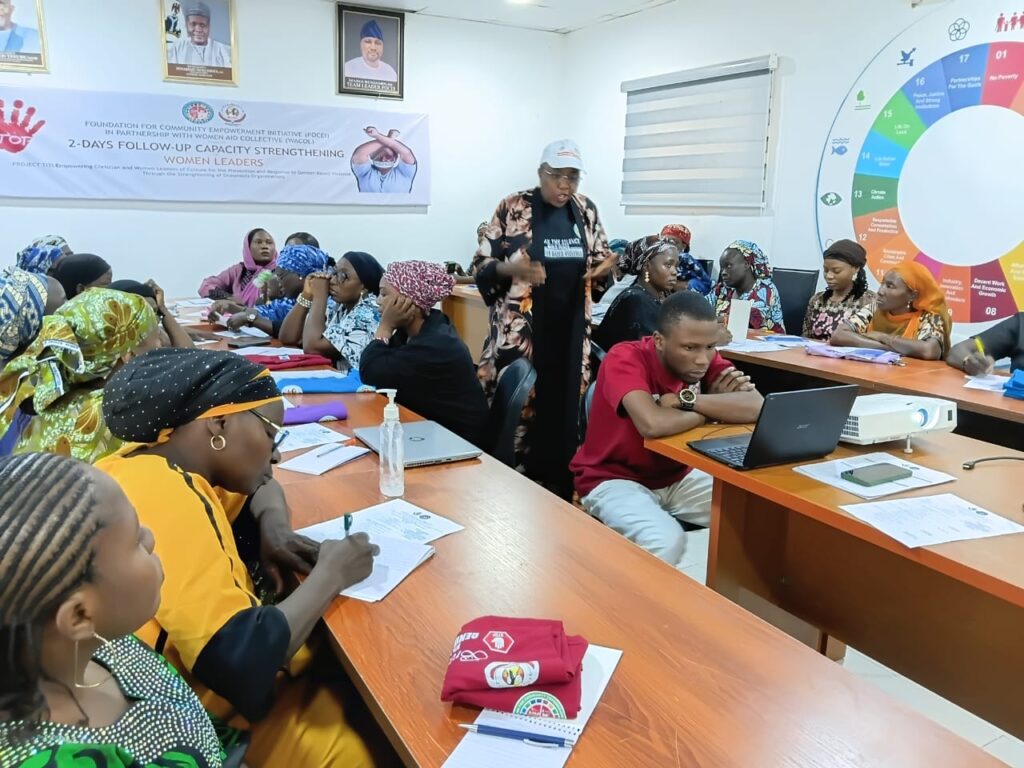
No fewer than 200 Christian Women leaders in two Gombe Communities have been outlined for a training on creating awareness on ways women can speak out against Gender Based Violence (GBV).
One of the impediments that has continued to stand against winning the war against GBV is the culture of silence especially by women who have suffered from one related form of GBV or the other.
Evidence has shown that some of these abuses have been perpetrated within the Church Communities or some cultural settings in Lijji and Zambuk, which the Foundation for Community Empowerment Initiative (FOCEI) in collaboration with Women Aid Collective (WACOL) seeks to address.
Mobilising these women to create the needed impact and desired change, FOCEI has commenced a two day scale-up capacity training of the first batch of 50 women fellowship leaders in Gombe on Friday. The training is aimed at escalating the voice of survivors in Lijji and Zambuk communities of Yamaltu-Deba LGA.
According to Dr Benjamin Maina, FOCEI Team Lead, “the training became imperative to sustain advocacy towards drastically reducing the high numbers of GBV cases within the society”.
He told the women that the training is also intended to equip them with requisite knowledge and skills about GBV as well as becoming ambassadors of anti GBV and at the same time impact other women in their communities and congregations about the different forms of GBV and how to address the scourge.
In their seperate presentations during training, Dr Leah Iliya Jalo, highlighted the types and context of GBV, faith reflections and GBV as a human rights violation with focus on inclusion.
Dr Fatima Sani, enlightened the women on cultural and religious context of GBV, cultural mapping, myth verses truth challenges as well as Faith in action while correcting misinterpretations and addressing GBV in religious spaces.
Mrs Amina Jafun, dwelled her presentation on Faith Foundation for GBV prevention, theological reflections as well as creating safe spaces and support systems in Faith communities.
She outlined the contributions of cultural and traditional leaders as partners in GBV prevention while advising on pathways for giving girls and women voices.
In her presentation, Dr Zainab Tijjani, said boys and girls should be trained and disciplined to see themselves as critical allies while also emphasizing the need to empower persons with disabilities as another way of addressing GBV.
She also spoke on breaking the barriers to justice and dignity in GBV related cases, brokering strategic multisectoral partnerships in addressing GBV as well as the partnership neded to address GBV.
She also echoed the need for equipping bystanders, influencing them from silent witnesses to active protectors.
End.