
Alexandra Mede
Two years after Barr. Oluwaseun Faleye assumed leadership of the Nigeria Social Insurance Trust Fund (NSITF), the Fund has become a growing regional reference pointand a benchmark for social security and employees’ compensation in Africa. In only two years, his administration changed the metrics of the Fund: processes are faster, more employers are registered, more beneficiaries are being compensated, and in all these, NSITF is repositioning itself as a critical pillar in President Ahmed Tinubu’s Renewed Hope Agenda.
The core mandate of NSITF is simple: Ensure that no Nigerian worker is left destitute after a workplace injury, occupational disease and disability, and that the dependents of a deceased worker, in the case of death arising out of employment, are not left stranded. In the last 24 months, that mandate has been given a new urgency. Barr. Faleye’s administration prioritized clearing the backlog of claims. New standard operating procedures have been introduced to fast-track verification and payment to beneficiaries. The goal, he has said repeatedly said, is “dignity in times of distress.”
Beyond compensation, the Fund has expanded sensitization across formal and informal sectors. Employers are being brought into compliance with the Employees’ Compensation Act, while workers are being educated on their rights to social protection. For many families who previously had no safety net, the Fund has become the difference between hardship and stability.
The Federal Government’s Renewed Hope Agenda places emphasis on job creation, poverty reduction, and inclusive growth. NSITF’s reforms are being deliberately framed within that vision. “Social security is not welfare. It is an investment in productivity,” a senior management official of the Fund noted, “when workers know they are protected, employers comply more, and the economy becomes more stable.”
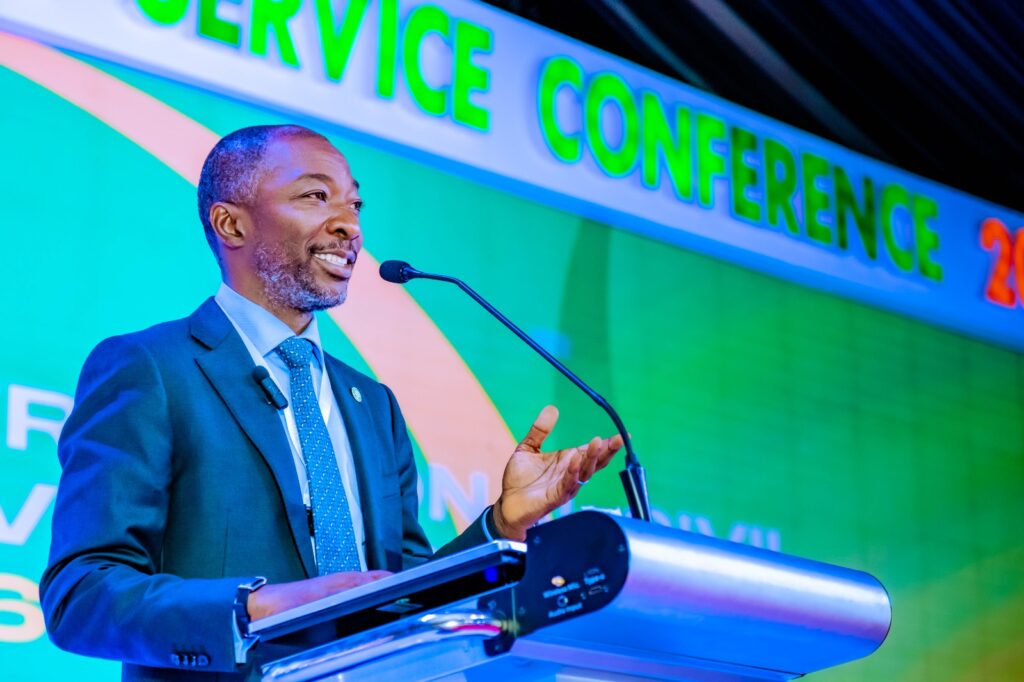
Under Faleye, NSITF has aligned its programmes with federal priorities: expanding coverage to more Ministries, Departments and Agencies (MDAs), supporting vulnerable workers, and ensuring that social protection contributes directly to national development goals. Indeed, the scheme has expanded significantly, enrolling over 7.8 million employees into the ECS. As at today, the NSITF has disbursed billions of naira in compensation to affected workers and dependents across various sectors, including oil and gas, banking, construction and the Civil Service amongst others. In addition to adequate compensation, it has also rehabilitated over 100 employees who suffered injuries and lost limbs in the course of work, restoring their hope and giving them back their lives.
Most importantly, the NSITF has extended its Employee Compensation Scheme (ECS) to cover the informal sector, providing a social safety net for millions of artisans, traders, and gig workers. The scheme aims to bridge the gap between the formal and informal economies, bringing millions of unprotected Nigerian workers into a secure social safety net. Falaye has conducted nationwide campaigns across the geopolitical zones, engaging with trade groups and unions. The Fund is actively collaborating with tech platforms (e.g., ride-hailing services) to ensure that independent collaborators can also participate in the social security scheme.
Perhaps the most visible transformation has been in technology. Two years ago, many NSITF processes were still paper-based, leading to delays and opacity. The Fund has now rolled out digital platforms for employer registration, contribution remittance, and claims processing. The e-NSITF portal and upgraded database have cut processing times and improved transparency. Workers and employers can track claims status in real time, a move that has boosted trust in the system. This digitalization has also helped NSITF expand its reach beyond Abuja and Lagos, bringing social insurance closer to workers in state offices across the country.
Organizationally, Barr. Faleye initiated a wide-ranging reorganization. Redundant units were streamlined, job roles were clarified, and performance metrics were introduced.
Equally important has been the focus on staff welfare. Training programmes, career development workshops, and improved communication channels have been introduced to raise morale. “An agency that protects workers must first take care of its own people,” Faleye told staff at a meeting. The result is a workforce that is more motivated and more accountable to the public it serves.
In a bid to adopt global best practices, NSITF under Faleye has deepened collaboration with sister agencies in Africa. It all started with the hosting of the 2026 the 2026 ISSA West Africa Technical Seminar in Abuja from April 22 to 23, 2026 where the NSITF helmsman saw the gathering as an important opportunity to strengthen social security in the West African sub-region. He recognized that the theme spoke directly to accessibility, effectiveness, inclusiveness, and the strategic use of digitisation in social security administration, describing them as practical measures foe social security institutions in the sub-region to keep pace with the changing lives and livelihoods of the people they exist to protect.
“Accessibility challenges us to rethink how services reach workers whose employment falls outside traditional structures. Effectiveness demands that benefits are delivered promptly, transparently, and predictably, because delays erode trust and inefficiency weakens credibility. Inclusiveness requires that women, persons with disabilities, migrant workers, and those in informal and non-standard forms of work are not treated as marginal, but as central to our mandate. Digitisation offers powerful tools in this regard, but only when guided by sound policy, institutional discipline, and a clear commitment to fairness,” he had enthused.
It is therefore not unexpected that many sister organizations in Africa have since then sought partnerships with NSITF to further imbibe best practices in social security, Recent partnerships included knowledge-exchange programmes with the Social Security and Housing Finance Corporation of The Gambia and the Compensation Fund of South Africa, as well as a visit from a high-level delegation from South Africa’s Rand Mutual Assurance (RMA).
The Board of the Industrial Injuries Compensation Fund (IICF) of the Gambia’s Social Security and Housing Finance Corporation (SSHFC) recently concluded a one-week study tour of the operations of the NSITF and the administration of Nigeria’s Employees’ Compensation Scheme. The event provided an avenue for both agencies to share ideas on institutional governance, employment injury compensation, compliance management, claims administration, rehabilitation programmes, research, actuarial planning and digital transformation. On the other hand, the visit from their South African counterparts culminated in a strategic Memorandum of Understanding (MoU) to collaborate on workers’ compensation, occupational safety and digital transformation in social insurance.
The reforms brought on by the present management of the Fund, as well as the collaborations with sister social security organizations, no doubt, highlight the importance of the vision statement of NSITF which is “To be the leading social security institutions in Africa, setting the agenda for change, social policy, economic empowerment and poverty alleviation in Nigeria.”
As Nigeria pushes to build a more resilient labour force under the Renewed Hope Agenda, NSITF’s transformation offers a case study in what focused leadership can do: take a statutory mandate and turn it into real protection for real people.
Mede, is Deputy General Manager Corporate Affairs and head of Department