By Joan Nwagwu
The Federal Government and the International Labour Organisation (ILO) have reaffirmed commitment to eliminating child labour through evidence-based policies and interventions driven by reliable national data.
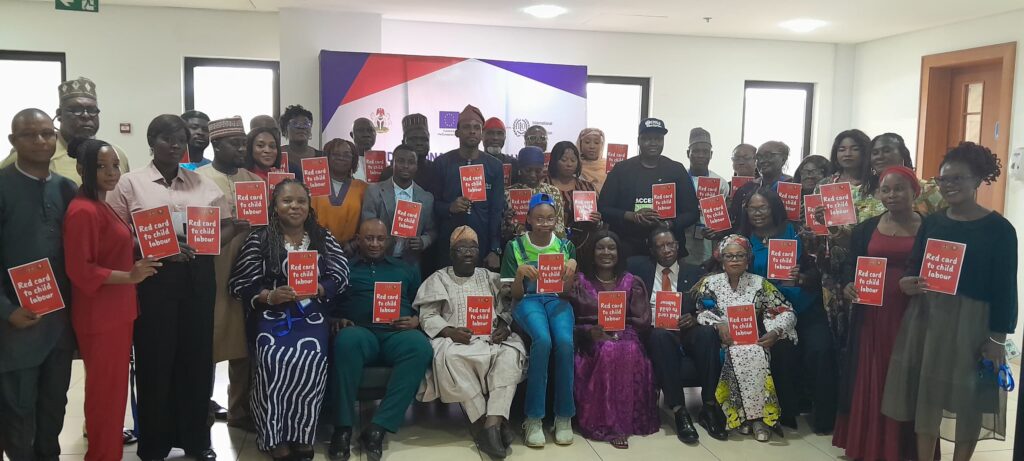
The Permanent Secretary, Federal Ministry of Labour and Employment, Dr Kamil Shoretire gave the assurance at the validation workshop of the 2024 National Child Labour Survey Report on Tuesday in Abuja,
Shoretire said that credible statistics remained indispensable for evidence-based policymaking, effective planning and efficient resource allocation in tackling child labour, forced labour, human trafficking and modern slavery.
He said the survey findings would provide deeper insights into the magnitude and trends of child labour, enabling stakeholders to target interventions, prioritise vulnerable sectors and strengthen collaboration nationwide.
According to him, reliable statistics are essential for evidence-based policy, effective planning and resource allocation.
The permanent secretary described child labour as a “major obstacle” to children’s rights and sustainable development saying, “it denied children education, exposed them to hazardous work and perpetuated poverty.
“This is particularly in agriculture, domestic work, mining, construction and street trading”.
Shoretire said Nigeria’s ratification of ILO Conventions Nos. 138 and 182, alongside the reviewed National Action Plan for the Elimination of Child Labour, 2026–2030, demonstrated government’s resolve to achieve Sustainable Development Goal (SDG) Target 8.7.
“The findings will strengthen labour inspection, improve social protection and promote responsible business conduct across supply chains,” he said.
He urged stakeholders to sustain collective action against child labour.
On her part, the ILO Country Director for Nigeria, Ms Vanessa Phala, said the validation exercise underscored Nigeria’s renewed determination to safeguard children through policies backed by credible evidence.
Phala, represented by Ms Inviolata Chinyangarara, ILO Senior Specialist on Workers’ Activities, said the survey highlighted progress recorded, existing gaps and priority areas requiring urgent interventions.
“This gathering is not simply about validating the report; it is about reaffirming our collective responsibility to the children of Nigeria, who are the future of this country.
“Behind every statistic is a child whose laughter, learning and future depends on the decisions we make today,” Phala said.
She urged policymakers and stakeholders to translate the findings into practical programmes that would protect vulnerable children and ensure they remained in school rather than workplaces.
Also, the Head of the Social Affairs Division, ECOWAS Commission, Dr Alves D’Almada, congratulated Nigeria for consistently producing labour statistics, describing the country as a “regional leader” in evidence generation.
D’Almada said child labour and forced labour remain major challenges across West Africa, adding that ECOWAS would continue strengthening regional strategies, partnerships and peer learning to address the problems.
“Child labour and forced labour remain major challenges in our region. We reaffirm ECOWAS’ commitment to eliminating both through stronger regional cooperation, peer learning and sustained action,” he said.
Statistician-General of the Federation and Chief Executive Officer of the National Bureau of Statistics (NBS), Mr Prince Adeniran, urged stakeholders to strengthen the report through constructive technical inputs.
Adeniran, represented by Mr Bishop Ohioma, Head of Field Service and Methodology Department, NBS, said participants’ observations would enhance the quality, credibility and policy relevance of the survey report.
“Your comments and recommendations are invaluable. They will help ensure that the report accurately reflects the realities of child labour in Nigeria and provides a robust evidence base for informed policy formulation,” he said.
He reiterated NBS’s commitment to producing quality official statistics that met international standards and appreciated development partners for supporting the survey and validation exercise.
“Together, we can produce a report that is technically sound, credible and impactful,” Adeniran said.